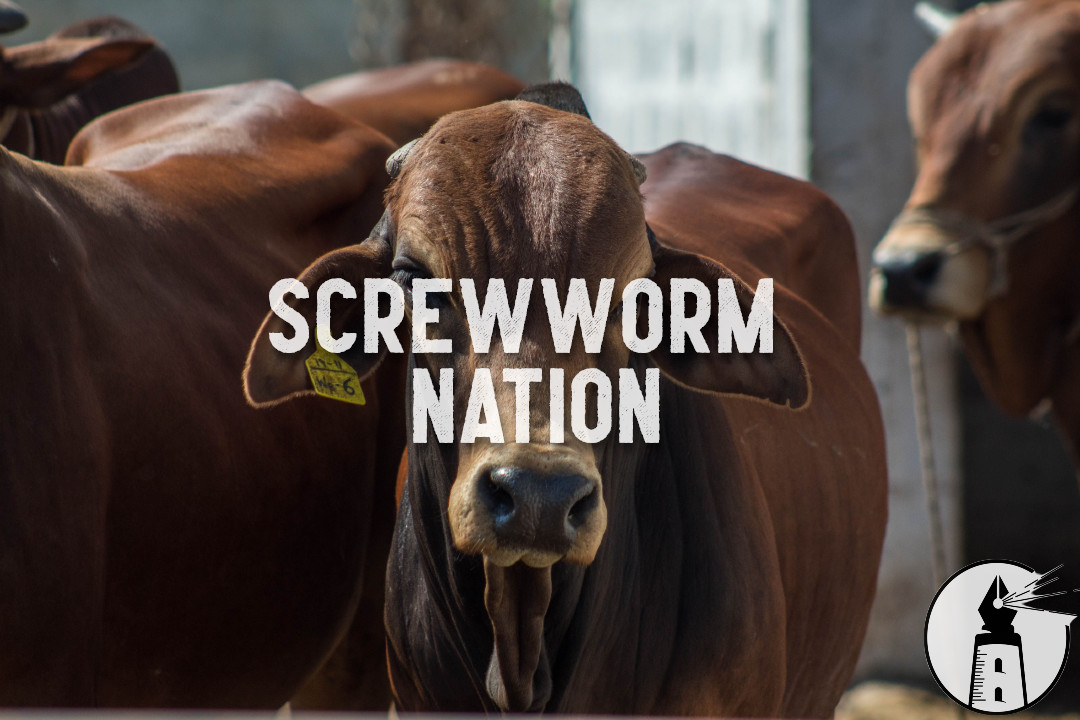
For decades, the New World screwworm was considered a solved problem in the United States. Through sustained eradication campaigns and international coordination, the parasite was pushed out of North America in one of the most celebrated victories in agricultural public health. That is why its recent reappearance in U.S. cattle has unsettled ranchers, regulators, and policymakers alike.
The discovery of infestations in Texas marks not only a biological setback but also a political one. It has quickly become a case study in how modern governments communicate risk, manage economic anxiety, and respond to threats that sit at the intersection of agriculture, trade, and public confidence.
A Familiar Pest Returns to Unfamiliar Attention
The New World screwworm is the larvae of a parasitic fly that lays eggs in open wounds of animals. Once hatched, the larvae feed on living tissue, often causing severe injury or death in livestock if untreated. The parasite was eradicated from the United States in the 1960s through an aggressive sterile insect program that remains one of the most successful biological control campaigns in history.
For decades afterward, a combination of surveillance and international containment efforts kept the pest confined to parts of Central and South America. The United States relied on a buffer system built through cross-border cooperation, sterile fly production, and early detection programs designed to prevent reinfestation.
That system is now under strain. Federal agricultural officials confirmed recent detections in U.S. cattle, raising concerns that the parasite’s northward spread had finally breached long-standing defenses.
Prevention Infrastructure and Its Political Visibility Problem
The screwworm outbreak highlights a recurring issue in public policy. Preventive systems are often invisible when they work and politically vulnerable when budgets are reviewed. Monitoring programs, international aid partnerships, and veterinary surveillance networks rarely generate public attention until a failure occurs.
For years, eradication efforts depended on coordination across borders, including sterile fly production facilities and monitoring systems in Central America. These programs were designed specifically to stop the pest before it reached U.S. livestock herds.
As the parasite has slowly expanded its range northward, questions have emerged about whether reductions in international assistance and surveillance capacity weakened early warning systems. Some analysts have pointed to cuts in programs associated with foreign monitoring and agricultural cooperation as potentially contributing factors, although there is no single confirmed causal link tying policy changes directly to the current outbreak.
What is clear is that the detection of screwworm inside the United States represents a breakdown in a layered defense system that depended heavily on early identification outside U.S. borders.
A Shift in Messaging as the Outbreak Reaches the Border
The political response to the outbreak has drawn increasing scrutiny, particularly as public messaging from agricultural officials has evolved alongside the crisis itself.
According to CNBC reporting, Agriculture Secretary Brooke Rollins described the screwworm as a “little pest” after its detection in the United States. That characterization stands in contrast to her earlier descriptions of the parasite as a “terrifying” threat when it was still approaching U.S. territory from abroad.
The shift in language reflects a broader effort by the administration to try to reassure consumers that the food supply remains stable and that the outbreak is under control. Rollins has emphasized that the U.S. Department of Agriculture is actively managing the situation and that the parasite does not pose a risk to food safety.
At the same time, she has suggested that earlier failures in border enforcement contributed to the pest’s spread, framing the issue in terms of national security and migration policy rather than solely administrative failure.
CNBC also reported that Rollins said the infestation “did not catch us off guard,” even as officials work to contain its spread. The messaging has focused heavily on preventing public alarm, particularly amid rising inflation and already elevated beef prices.
Economic Pressure and Political Framing
The timing of the outbreak adds another layer of sensitivity. Beef prices have been rising in a broader inflationary environment, and agricultural markets are already under strain from supply constraints.
The screwworm poses an additional risk because infestations can lead to quarantines, livestock movement restrictions, and increased veterinary costs. Even limited outbreaks can disrupt supply chains and create localized price pressure.
A report cited by CNBC from the Dallas Federal Reserve estimated that a major resurgence comparable to historical outbreaks could result in billions of dollars in economic damage, primarily through livestock losses and market disruptions.
In public statements, administration officials have emphasized that the food supply remains safe and that beef products are not affected by the parasite. They have also argued that containment efforts are already underway and that the situation is being managed effectively.
At the same time, political blame has become part of the narrative. Officials have pointed to prior administration policies and border management as contributing factors, while opposition figures have criticized current leadership for underestimating the threat and for cuts to preventive programs that may have reduced surveillance capacity.
A Long History of Containment and Complacency
The United States has dealt with screwworm before, and the historical record shows that eradication is possible. The sterile insect technique remains a model for biological control, and similar strategies continue to be used globally for pest management.
But history also shows that eradication does not guarantee permanence. Once a species is eliminated from a region, maintaining that status requires continuous investment in monitoring and cross-border coordination.
The return of screwworm therefore raises a familiar question in agricultural policy. How much should be spent to prevent a crisis that may never occur, versus how much is justified after the crisis has already begun?
That tradeoff is now being debated in real time.
Conclusion
The reappearance of screwworm in the United States is both a biological and institutional stress test. It challenges long-standing assumptions about agricultural security and highlights the fragility of systems that depend on constant vigilance.
The evolving messaging from officials, including recent remarks described in CNBC reporting, illustrates how quickly the tone of crisis communication can shift once a threat becomes domestic. What was once framed as a severe external danger is now being described in more restrained terms as manageable and contained.
Whether that shift reflects appropriate reassurance or political recalibration will likely be debated long after the outbreak is controlled. What is clear is that the screwworm’s return is not just about a parasite. It is about the systems built to keep it away and what happens when those systems are ignored.
—Greg Collier