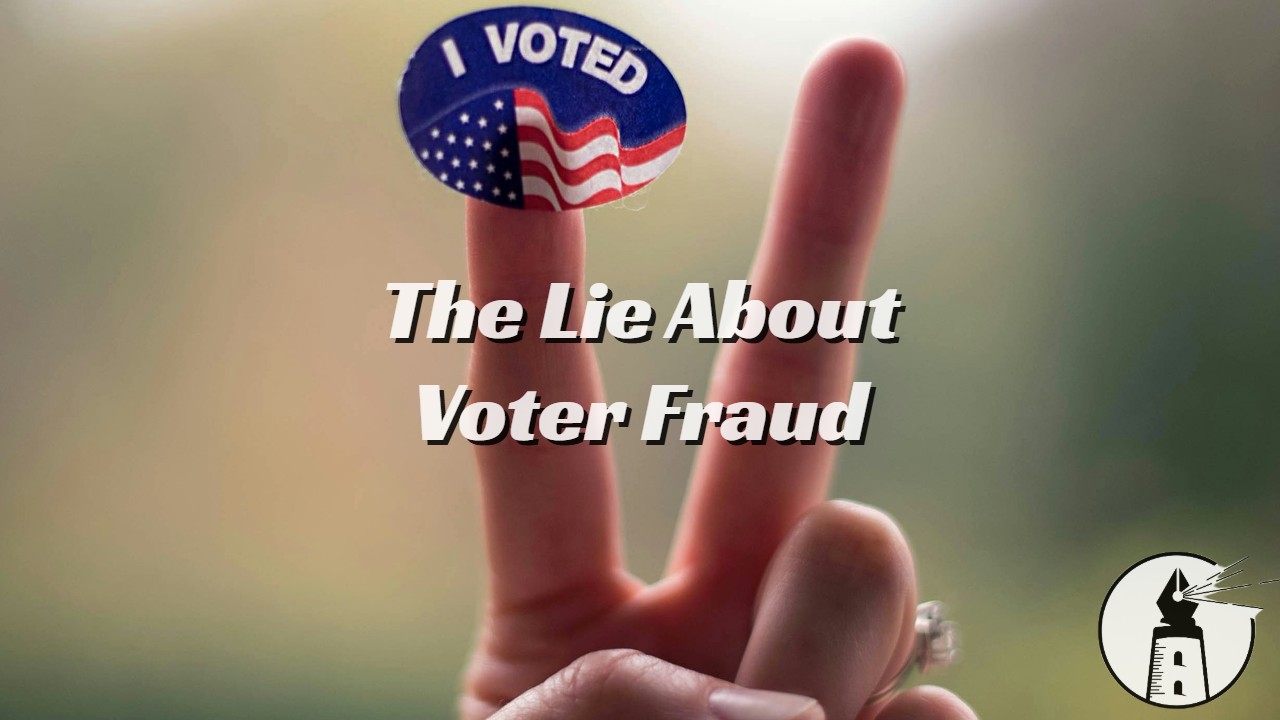
Claims of widespread voter fraud have become a familiar feature of American politics. They surface before elections, spike after close results, and are often used to justify new restrictions on voting. The underlying narrative is simple: without tighter rules, elections cannot be trusted.
The evidence tells a very different story.
Decades of research, court findings, and election data consistently show that voter fraud in the United States is extraordinarily rare. At the same time, strict voter identification laws create real barriers for eligible voters, disproportionately affecting women, low-income citizens, people of color, the elderly, students, and people with disabilities.
This disconnect between perception and reality matters. When policy is built on fear rather than facts, the result is not stronger democracy. It is a narrower one.
The scale of voter fraud does not match the rhetoric
The most important fact in the voter fraud debate is also the least discussed: there is no evidence of widespread in-person voter impersonation, the only type of fraud that voter ID laws are designed to prevent.
The Brennan Center for Justice has conducted extensive reviews of election data and court records. Its research has repeatedly found that voter impersonation is vanishingly rare, with rates measured in hundredths of a percent or lower. In multiple national studies, the Brennan Center found that alleged cases of in-person fraud amounted to between 0.0003 percent and 0.0025 percent of votes cast.
These are not theoretical estimates. They are drawn from actual prosecutions, investigations, and verified reports.
Even sources often cited by fraud advocates tell a similar story. The Heritage Foundation maintains a public database of election fraud cases. Despite years of searching and litigation across thousands of elections, its database documents only a small number of proven cases nationwide, most of which involve absentee ballot issues or registration irregularities rather than in-person impersonation at polling places.
When tens or hundreds of millions of ballots are cast, and only a handful of impersonation cases appear over decades, it becomes clear that this is not a systemic threat.
Federal investigations have reached the same conclusion
The federal government has examined this issue directly. A comprehensive Government Accountability Office study compared states with strict voter ID laws to those without them and found no evidence that such laws reduced fraud. What the GAO did find was that turnout declined in states that adopted strict ID requirements, particularly among younger voters and newly registered voters.
This is a critical point. If voter ID laws addressed a real problem, one would expect to see measurable fraud reduction. Instead, the measurable effect is reduced participation.
The Department of Justice has also brought very few voter impersonation cases over many election cycles, despite extensive scrutiny. Courts reviewing voter ID statutes have repeatedly noted the absence of evidence showing that in-person fraud is a meaningful problem.
In 2014, a federal court striking down Wisconsin’s voter ID law observed that the state had not identified a single instance of in-person voter impersonation. Similar findings appear in rulings from Texas, North Carolina, and elsewhere.
What voter ID laws actually do
Supporters of voter ID laws often frame them as common-sense safeguards, comparing them to ID requirements for buying alcohol or boarding a plane. That analogy fails for a basic reason. Voting is a constitutional right. Buying beer and flying commercially are not.
When a state conditions voting on possession of specific documents, it shifts the burden onto citizens to prove their eligibility in advance, even when there is no evidence of widespread abuse.
Millions of Americans do not have the forms of identification required by strict voter ID laws. The Brennan Center estimates that approximately 11 percent of U.S. citizens lack government-issued photo ID, including higher percentages among Black voters, Latino voters, low-income households, and elderly citizens.
Obtaining ID is not always simple. It can require birth certificates, transportation to distant offices, time off work, and fees. For people living paycheck to paycheck, caring for family members, or managing disabilities, these hurdles are not minor inconveniences. They are real barriers.
Courts have recognized this. In multiple cases, judges have found that voter ID laws impose disproportionate burdens on minority voters and low-income communities, raising serious concerns under the Voting Rights Act and the Constitution.
The discriminatory impact is well documented
The discriminatory effects of voter ID laws are not hypothetical. They show up in data and in lived experience.
A study published in the journal Political Science Quarterly found that strict voter ID laws reduce turnout among minority voters more than among white voters.
The American Civil Liberties Union has documented how voter ID requirements disproportionately affect Black voters, elderly voters, students, and people with disabilities, often in communities that already face structural barriers to political participation.
These disparities are not accidental. Identification access in the United States reflects broader inequalities in income, housing stability, and access to government services. When voting rules rely on documents that are unevenly distributed, the electorate becomes less representative.
That outcome does not strengthen democracy. It distorts it.
Voter ID does not address the real vulnerabilities in elections
Even if voter impersonation were more common, voter ID laws would still miss most genuine election risks.
Experts in election security consistently point out that the more serious threats involve voter registration systems, election infrastructure, misinformation campaigns, and administrative errors. These are complex challenges that require investment in cybersecurity, auditing, and election administration.
Voter ID laws do little or nothing to address these issues. Instead, they focus on a narrow scenario that rarely occurs while leaving more consequential vulnerabilities untouched.
The National Academies of Sciences, Engineering, and Medicine has emphasized that election integrity depends on secure voting systems, reliable audits, and resilient infrastructure, not simply on ID requirements at polling places.
In other words, voter ID is a symbolic solution to a largely imaginary problem.
Fear persists because it is politically useful
If voter fraud is so rare, why does the narrative persist?
Part of the answer lies in political incentives. Claims of fraud can delegitimize unfavorable outcomes, mobilize supporters, and justify restrictive policies. They also tap into broader anxieties about demographic change and political power.
Repeated investigations into the 2020 election found no evidence of widespread fraud. More than sixty court challenges failed, often because plaintiffs could not produce credible evidence. Yet belief in massive fraud remains high among certain segments of the public.
This persistence is not driven by data. It is driven by messaging.
When people hear claims repeated often enough, especially by trusted political figures, they begin to feel true even in the absence of proof.
Democracy works best when participation is maximized
The core question is not whether elections should be secure. They should. The question is how security is achieved.
A healthy democracy aims to make voting both accessible and reliable. That means accurate voter rolls, transparent procedures, paper ballots or verifiable records, post-election audits, and professional election administration. It does not mean erecting barriers that prevent eligible citizens from participating.
Countries with strong democratic systems focus on facilitating registration and voting, not restricting it. Many automatically register voters or provide national ID cards to all citizens at no cost. The United States does neither consistently.
Instead, it places the burden on individuals to navigate a fragmented system and then justifies exclusion in the name of preventing fraud that rarely occurs.
The bottom line
There is no evidence of widespread voter fraud in the United States. Multiple independent studies, court rulings, and government investigations have confirmed this.
What does exist is a pattern of laws that make voting harder for certain groups of citizens, often under the guise of security. These laws solve a problem that does not meaningfully exist while creating new problems that undermine democratic participation.
Voter ID requirements do not protect elections in any measurable way. They restrict access, disproportionately harm marginalized communities, and erode trust by implying that voters themselves are the threat.
If the goal is secure, legitimate elections, the path forward lies in strengthening infrastructure, transparency, and administration. It does not lie in making eligible citizens prove themselves worthy of the ballot.
Democracy is not preserved by narrowing the electorate. It is preserved by ensuring that every eligible voice can be heard.
—Greg Collier