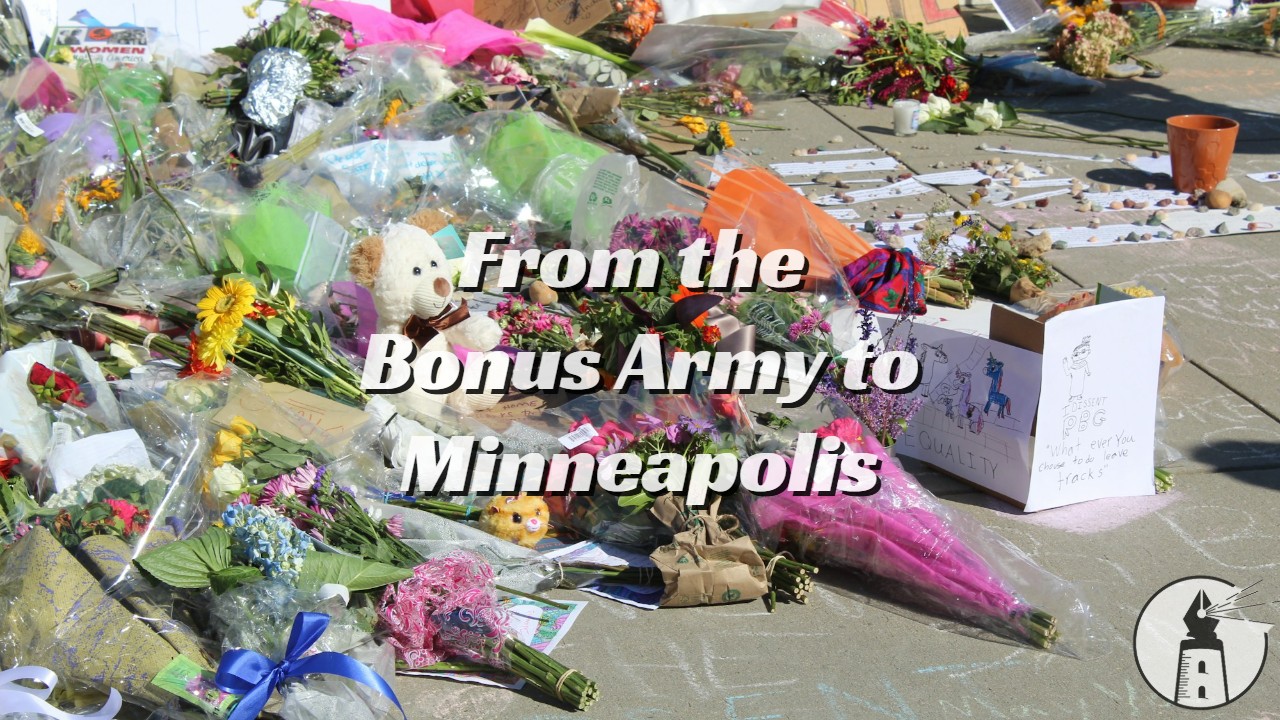
The most unsettling thing about the shooting of Alex Pretti is not the now-familiar argument over whether an agent felt “threatened.” It is the quiet way we have accepted that federal immigration officers, agents whose authority was never meant to resemble domestic riot control, were deployed into a public space, armed, aggressive, and empowered to use lethal force against a U.S. citizen engaged in political dissent. That should stop us cold. Once immigration enforcement becomes indistinguishable from federalized street policing, the question is no longer about one man’s death in Minneapolis. It becomes a question about how far the federal government can stretch its power before constitutional limits become optional rather than binding.
This is not the first time the federal government has persuaded itself that extraordinary force was justified by extraordinary circumstances. In 1932, World War I veterans, known as the Bonus Army, gathered in Washington, D.C., demanding promised compensation during the Great Depression. They were treated not as citizens exercising the right to petition their government but as a problem to be removed. The Army was deployed, the cavalry charged, and the protestors’ camps were burned. In 1970, students protesting the Vietnam War at Kent State were framed as threats to public order rather than participants in democratic expression. The Ohio National Guard opened fire. Four students were killed. In both cases, officials pointed to fear, confusion, and the need to restore order. History responded differently.
The shooting of Alex Pretti belongs in that lineage, not because the facts are identical, but because the logic is. When government authority is under stress, when dissent is redefined as danger, and when armed agents are placed into volatile civilian spaces, lethal outcomes stop being anomalies and start becoming foreseeable.
What makes the Pretti case especially troubling is not only that force was used but also who used it and why they were there. Immigration enforcement agencies exist to enforce immigration law. They were never intended to function as general-purpose crowd control or protest policing units. That distinction matters. The Constitution does not grant the federal government a general police power. Authority over civilian life was deliberately fragmented and localized to prevent the concentration of force that leads to abuse.
Over time, that boundary has weakened. Federal agencies increasingly operate with overlapping missions, militarized equipment, and limited external oversight. When immigration agents appear at protests armed and equipped for confrontation, the public is no longer encountering a narrow administrative function. It is confronting the physical presence of federal power in spaces historically protected for speech, assembly, and dissent.
Supporters of the operation often return to a single point: the presence of a firearm. Alex Pretti was armed; therefore, the shooting was inevitable, justified, or unavoidable. That argument collapses under scrutiny. The right to bear arms, whatever one’s view of its scope, does not erase other constitutional protections. It does not transform protest into provocation. It does not grant federal agents unlimited discretion to escalate encounters absent a clear and immediate threat.
Kent State remains instructive here. The students who were killed were not armed insurgents. They were not charging the Guard. The shootings unfolded amid confusion, fear, and misinterpretation. Later investigations found no clear order to fire. What existed instead was an atmosphere in which armed authority perceived disorder as danger and acted accordingly. Constitutional limits exist precisely to prevent that kind of fatal misjudgment.
The Bonus Army episode illustrates another danger. When political pressure mounts, governments are tempted to redefine citizens as threats. The veterans in Washington were lawful and organized. Their demands were inconvenient. The response was overwhelming force. Officials defended it at the time as necessary to restore order. History remembers it as a failure of democratic restraint.
Alex Pretti’s death demands a similar reckoning. Not because he was a veteran seeking benefits or a student opposing a war, but because he was a citizen caught at the intersection of protest, federal authority, and a government increasingly willing to deploy armed agents into civilian life without clear limits or public accountability.
There is also a structural problem embedded in cases like this. Local police departments, for all their flaws, operate under municipal oversight, state law constraints, and at least some form of civilian review. Federal agents operate within a far more opaque system. Investigations are internal. Discipline is uncommon. Legal doctrines further insulate agents from consequence. When lethal force is used, the public is asked to trust a process it cannot observe.
That opacity erodes confidence and reverses the constitutional relationship between the citizen and the state. In a functioning democracy, the government bears the burden of justifying its use of force. Increasingly, that burden has shifted to the public to prove that a killing was unjustified. That is not a healthy or sustainable model of governance.
This argument is not a claim that federal agents are uniquely malicious, nor that immigration law should not be enforced. It is not a denial that volatile situations exist or that officers face real risks. Those realities can coexist with a more fundamental concern: that we are normalizing a form of federal enforcement that treats civilian spaces as hostile terrain and dissent as escalation.
Kent State did not immediately restrain the use of force. The Bonus Army did not immediately limit federal authority. But both became markers, warnings about what happens when the state points weapons inward and calls it order. They remind us that legality and legitimacy are not the same thing and that constitutional damage often occurs long before courts or commissions respond.
Alex Pretti should not be reduced to a symbol in a partisan argument. His death raises a broader and more troubling question about where federal power ends and whether we still recognize the difference between enforcing the law and turning it inward against the public it exists to serve.
As investigations continue, official statements will emphasize split-second decision making, perceived threats, and compliance with policy. That is standard practice. But video evidence and eyewitness accounts already circulating complicate those claims. They show moments of confusion and escalation that do not align neatly with simplified narratives of imminent danger.
History suggests that these discrepancies matter. At Kent State, it took years for the official record to catch up to what photographs and film already indicated. The same was true after the Bonus Army was forcibly removed from Washington under the banner of restored order.
The point is not to adjudicate the case before investigators complete their work. It is to resist the reflexive closure that so often follows state violence. The idea that the presence of a weapon ends the inquiry. The assumption that official accounts deserve automatic deference. The belief that constitutional questions can be deferred indefinitely in the name of security. They cannot. Moments like this demand closer scrutiny, not less.
—Greg Collier