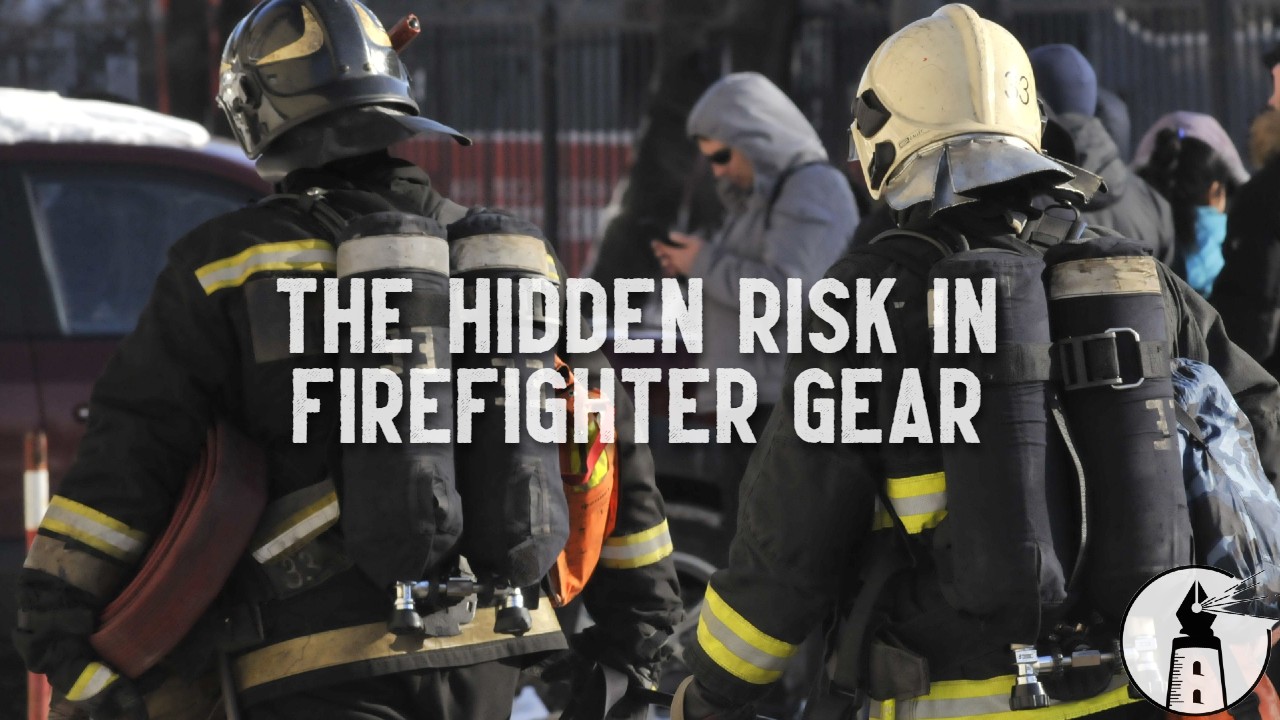
Firefighters put on protective gear because the job they are about to do can kill them.
The heavy coats, pants, gloves, and hoods that make up their turnout gear are designed to protect them from extreme heat, flames, water, and the many hazards encountered inside a burning building. For decades, that equipment has represented one of the most important lines of defense between firefighters and the dangers of their profession.
Now, however, some firefighters and municipalities across the country are raising an unsettling question: What if some of the equipment designed to protect firefighters is also exposing them to potentially hazardous chemicals?
The chemicals at the center of that question are PFAS, a large family of synthetic compounds commonly known as “forever chemicals.” PFAS have been used because of their resistance to heat, water, oil, and stains. Those same properties have made them useful in protective clothing.
In September, the issue moved into the courts again. A federal judge allowed a lawsuit brought by Connecticut firefighters and firefighter organizations against companies including 3M, DuPont, and Honeywell to proceed in part. The plaintiffs allege that PFAS-containing protective gear exposed firefighters to chemicals associated with serious health risks.
A separate lawsuit filed this week by the city of Keene and the town of Londonderry, New Hampshire, seeks to recover the cost of replacing PFAS-containing firefighter gear.
The lawsuits do not establish that the gear caused cancer or other illnesses. Those questions remain subjects of scientific and legal debate. But the underlying issue is no longer hypothetical. Federal researchers have confirmed that PFAS can be found in firefighter protective equipment.
What Exactly Are PFAS?
PFAS stands for per- and polyfluoroalkyl substances. It is not the name of one chemical but a large family containing thousands of individual compounds.
The Environmental Protection Agency explains that PFAS have been used in industrial and consumer products since the 1940s because of their useful resistance to heat, water, oil, and stains. Many PFAS break down very slowly and can remain in the environment for long periods.
The chemicals have been used in products ranging from industrial materials and food packaging to firefighting foams and water-resistant products.
Some PFAS have also been used in firefighter turnout gear because protective clothing needs to repel water and resist the extreme conditions encountered during firefighting.
That creates an unusual occupational-health problem. The same chemical characteristics that can make a piece of protective equipment more effective at keeping water away from a firefighter can also make the material a potential source of PFAS exposure.
Researchers Found PFAS in Firefighter Gear
The question of whether firefighter gear contains PFAS is no longer based solely on allegations made in lawsuits.
The National Institute of Standards and Technology has been systematically studying the issue since Congress directed the agency to investigate PFAS in firefighter equipment.
In a 2023 study, NIST examined 20 textiles used in firefighter turnout gear. Researchers detected between one and 17 different PFAS in each textile they tested, with higher numbers of detections and higher concentrations in some of the outer-shell and moisture-barrier materials.
That research did not determine that the gear was causing disease. Instead, it established something more basic and important: PFAS are present in materials used to manufacture firefighter protective clothing.
NIST continued that research in 2026. In a study published in May, researchers examined firefighter hoods, gloves, and wildland firefighting clothing after exposing the materials to conditions intended to simulate some of the stresses they experience during use.
The results were complicated. Measurable PFAS levels increased in some hoods and gloves following heat or abrasion testing, while PFAS measurements decreased in some wildland gear after weathering and abrasion.
NIST emphasized that the results do not establish what those changes mean for a firefighter’s health. The research measured the chemicals, rather than determining whether exposure from the gear causes disease.
That distinction is important. Finding PFAS in a material is not the same thing as proving that the material causes cancer.
But identifying the chemicals is an essential first step in determining whether exposure from the equipment could matter.
Firefighters Already Face Multiple Exposure Routes
PFAS in protective gear also cannot be considered in isolation.
Firefighters encounter a complicated mixture of chemicals during their work. Burning buildings can release substances from plastics, furniture, insulation, carpeting, and other materials. Firefighters can also encounter chemicals through specialized firefighting foams and other occupational sources.
The National Institute for Occupational Safety and Health has been studying firefighter exposure for years.
In a 2026 health hazard evaluation, NIOSH identified several potential occupational routes for PFAS exposure, including firefighting foams, contaminated dust, and potentially contact with turnout gear. The agency noted that firefighters can encounter PFAS during both routine station activities and emergency response.
That means determining the health consequences of PFAS exposure among firefighters is particularly difficult.
A firefighter may be exposed to chemicals from burning materials, contaminated gear, firefighting foam, and other sources over the course of a career. Separating one exposure from another is a significant scientific challenge.
It is therefore too early to say that PFAS-containing turnout gear is responsible for the elevated cancer rates observed among firefighters.
It is equally difficult to dismiss the question simply because firefighters have other exposures.
The Connecticut Lawsuit
That uncertainty is now playing out in federal court.
The Connecticut case involves 13 firefighter organizations and 12 individual firefighters who allege that PFAS in protective gear increased their exposure to the chemicals and contributed to health risks.
On September 15, U.S. District Judge Alvin Thompson issued a ruling allowing some of the claims to proceed while dismissing others.
The ruling is important because it does not represent a finding that the companies caused firefighters’ illnesses. Instead, it determines which claims can continue through litigation.
According to the court’s order, some claims were dismissed, including certain claims brought by union plaintiffs involving medical monitoring and damages. Other portions of the case survived the defendants’ efforts to have the claims dismissed.
The distinction matters because court decisions allowing allegations to proceed are not findings that those allegations have been proven.
The case will now provide an opportunity for the parties to present evidence about the chemicals used in firefighter gear, how firefighters may have been exposed, and whether those exposures can be connected to the health effects alleged by the plaintiffs.
New Hampshire Adds Another Dimension
The issue expanded again this week when Keene and Londonderry, New Hampshire, filed a federal lawsuit against manufacturers of PFAS-containing firefighting equipment.
This case is different from the Connecticut litigation because the municipalities are seeking to recover the costs of replacing the gear, rather than simply pursuing individual health claims.
According to reporting by the Concord Monitor and New Hampshire Public Radio, the municipalities say they have faced significant public expense as they replace equipment with PFAS-free alternatives.
The complaint estimates that a set of turnout gear costs approximately $4,000. It also estimates that replacing the equipment for New Hampshire’s roughly 5,900 firefighters could cost approximately $47 million.
Those figures illustrate why the issue has implications far beyond individual lawsuits.
Fire departments are public institutions. When equipment must be replaced, taxpayers may ultimately bear some or all of the cost.
The lawsuit alleges that manufacturers knew or should have known that PFAS could be released from turnout gear during normal use, wear, abrasion, laundering, and handling. Those are allegations made by the plaintiffs, not findings established by the court.
But they raise an important practical question for fire departments around the country: If PFAS-free protective equipment is available, who should pay to replace older equipment that contains PFAS?
The Health Question Is More Complicated
There is substantial scientific evidence that exposure to certain PFAS can be associated with adverse health effects. But PFAS is an enormous chemical family, and researchers do not have the same amount of evidence for every compound.
The Agency for Toxic Substances and Disease Registry says epidemiological research has identified associations between exposure to specific PFAS and several health effects, including increased cholesterol, reduced antibody response to some vaccines, changes in liver enzymes, pregnancy-related hypertension, and kidney and testicular cancers.
ATSDR also emphasizes that health risks depend on factors including the specific chemical, the dose, frequency and duration of exposure, and the route through which exposure occurs.
That caution is particularly important when discussing firefighters.
It would be misleading to take evidence about one PFAS compound and automatically apply it to every chemical found in turnout gear. It would also be misleading to assume that detecting PFAS in clothing means a firefighter has received a harmful dose.
Scientists still need to determine how much PFAS can migrate from protective equipment, how firefighters are exposed during actual use, how exposure changes as gear ages, and how those exposures compare with other sources.
The Gear Can Also Become Contaminated at Fires
There is another layer to the problem.
Even if manufacturers eventually eliminate PFAS from protective equipment, firefighters will still have to deal with hazardous substances that contaminate their gear during fires.
NIOSH says firefighters can be exposed to hundreds of chemicals generated by burning materials. Those substances can remain on or inside protective clothing after a fire.
Research has shown that contaminants can transfer from gear to firefighters’ skin and can also spread to vehicles, fire stations, and other environments.
That is why NIOSH recommends careful decontamination, cleaning, removal, and storage of turnout gear.
In other words, replacing PFAS-containing equipment would not make firefighter exposure disappear. It would address one potential source while leaving firefighters with the much larger problem of chemical contamination created by the fires themselves.
A Safety Device Creates a Difficult Question
The controversy over PFAS in firefighter gear presents a difficult problem because there is no simple villain and no simple solution.
Firefighters need equipment that can withstand extraordinary conditions. Protective clothing has to resist heat, flames, and water while allowing firefighters to move and work in dangerous environments.
Manufacturers have spent decades developing materials capable of doing that job.
At the same time, society has learned much more about the potential consequences of widespread exposure to certain PFAS compounds.
The challenge is determining how to preserve the lifesaving properties of firefighter equipment while eliminating unnecessary chemical exposure.
That is a problem that science, manufacturers, fire departments, and regulators will have to address together.
The Question Behind the Lawsuits
The most important part of the PFAS firefighter story may ultimately have little to do with the courtroom.
It is about how society responds when a product designed to protect people turns out to contain chemicals that may present a different kind of risk.
The science is not finished. The lawsuits have not established that PFAS-containing turnout gear causes cancer. Researchers are still determining how much exposure firefighters receive from their equipment and what health consequences, if any, can be attributed specifically to that exposure.
But one fact is already established: federal researchers have found PFAS in firefighter protective equipment, and they are studying what happens to those chemicals when the gear is subjected to the heat and wear of actual firefighting conditions.
For firefighters who spend their careers running toward danger while the rest of us run away from it, that question deserves serious attention.
Protective equipment should protect the people wearing it.
The challenge now is making sure it does.
—Greg Collier