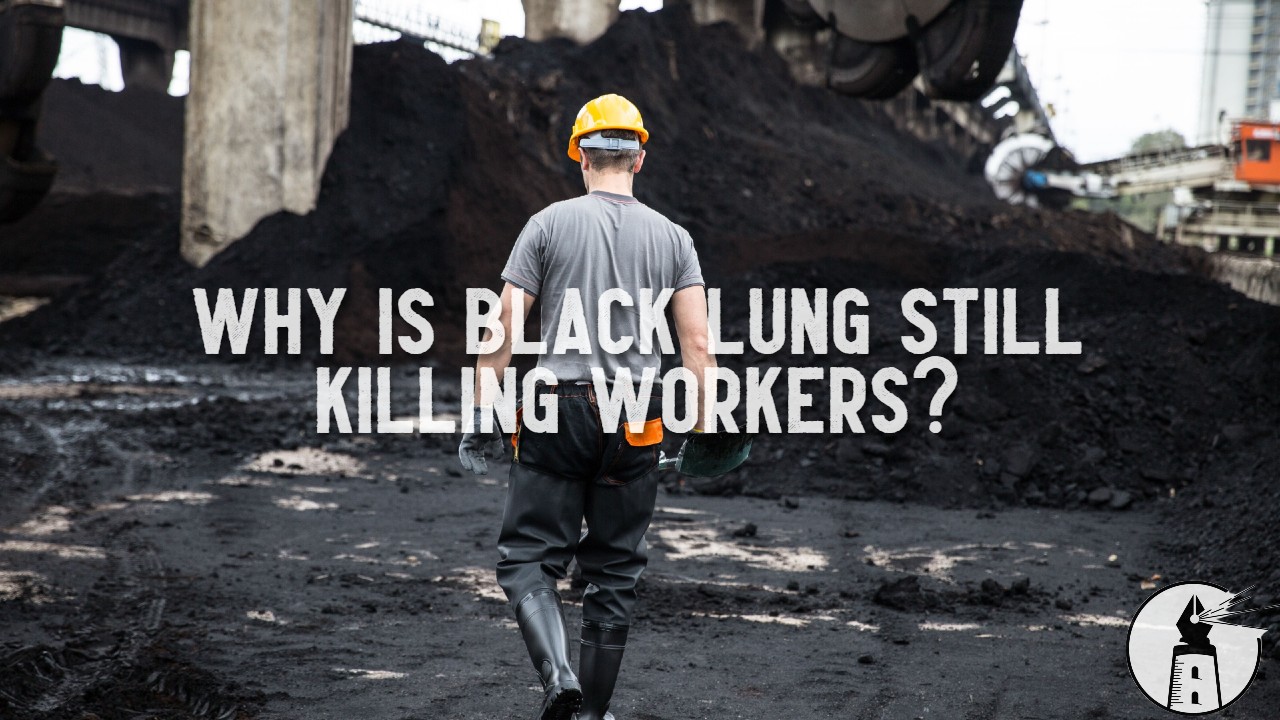
There was a time when black lung was considered an inevitable consequence of working in a coal mine. Miners spent decades underground breathing coal dust, and many eventually developed the respiratory disease that became one of the most recognizable occupational hazards in America.
We know better now.
Scientists have understood the connection between inhaling dust and developing serious lung disease for generations. Workplace regulations have been written specifically to limit those exposures. Monitoring programs exist. Protective equipment exists. Medical screening exists.
And yet American workers are still developing severe, sometimes fatal lung diseases caused by what they breathe on the job.
That is what makes recent reporting about black lung and silicosis so troubling. An investigation by The Guardian examined the continuing problem among coal miners in Appalachia as well as a newer epidemic among workers who manufacture engineered-stone countertops. The industries are different, but the underlying problem is remarkably similar: workers are being exposed to hazardous dust that can permanently damage their lungs.
The story is not simply about coal mining. It is about what happens when a workplace hazard is well understood, but preventing it depends on whether protections are actually implemented and followed.
Black Lung Was Never a Mystery
Black lung, formally known as coal workers’ pneumoconiosis, develops when miners inhale respirable coal mine dust over time. According to the National Institute for Occupational Safety and Health’s information on black lung, coal mine dust is the cause of the disease, which can become disabling and can contribute to a miner’s death.
The disease can range from relatively mild cases to complicated forms that severely impair a person’s ability to breathe. There is no treatment that simply reverses the scarring once advanced disease has developed.
The important point is that black lung is preventable.
The federal government has been studying the disease for decades. NIOSH’s Coal Workers’ Health Surveillance Program was established under the Federal Coal Mine Health and Safety Act of 1969 and continues to provide screenings while tracking respiratory disease among miners.
NIOSH also conducts research into engineering controls, dust monitoring, and other methods of reducing miners’ exposure. Its screening program provides eligible coal miners with examinations at no cost, including chest X-rays and spirometry, a test of lung function.
The problem, then, is not that Americans have failed to discover what causes black lung. The problem is that knowing how to prevent an occupational disease does not automatically mean that every worker is protected from it.
And recent research suggests the consequences are becoming increasingly difficult to dismiss.
A Disease Returning in a New Generation
The traditional image of black lung involves an older miner who spent much of his working life underground.
That image no longer tells the whole story.
The Guardian reported this month that black lung has been appearing in younger Appalachian coal miners, including miners who developed serious disease after considerably less time in the mines than previous generations.
The problem is not entirely new. NIOSH research has previously documented particularly serious respiratory disease among miners in Central Appalachia. A NIOSH analysis found that modern coal miners had significantly increased odds of death from coal workers’ pneumoconiosis, chronic obstructive pulmonary disease, and lung cancer compared with the general U.S. population. The risks were particularly severe among miners in Kentucky, Virginia, and West Virginia.
More recent research cited by The Guardian found that roughly one in three coal miners examined in Central Appalachia had evidence of black lung disease. That region includes Kentucky, Virginia, and West Virginia.
Those numbers are startling because they challenge the assumption that improvements in mining technology and workplace regulation have made the problem largely a relic of the past.
For miners and their families, black lung is not a historical footnote. It is an ongoing occupational disease.
Silica Adds Another Threat
Coal dust is not the only danger facing miners.
Crystalline silica is found in rock and other materials encountered during mining. When rock is cut, crushed, or otherwise disturbed, extremely small particles can become airborne and enter the lungs.
NIOSH notes that silicosis can affect workers in many types of mines and quarries, including coal mines. The agency also reports that changes in the types of lung abnormalities found among Central Appalachian miners suggest that crystalline silica exposure has become an increasingly important concern.
Silica exposure is particularly important because it connects the traditional black lung problem to a much broader occupational health issue.
A miner does not have to spend decades underground to encounter a hazardous dust exposure. Workers in entirely different industries can face the same basic danger.
That brings us to one of the most disturbing parts of the current story.
Black Lung Is Not Just a Coal Story Anymore
In recent years, doctors have documented severe silicosis among workers who manufacture countertops from engineered stone.
Engineered stone, sometimes called “quartz countertop material,” can contain extremely high concentrations of crystalline silica. Cutting, grinding, and polishing the material can release respirable particles that workers can inhale.
A study published in NEJM Evidence in August 2026 provides a sobering picture of the problem. Researchers from the California Department of Public Health and other institutions identified 592 cases of silicosis among California workers who fabricated engineered-stone countertops between January 2019 and June 2026.
Of those workers, 65 underwent lung transplantation, and 31 died.
The study published by NEJM Evidence also found that the workers were frequently diagnosed at relatively young ages and that some developed severe disease after comparatively limited periods of occupational exposure.
These workers were not coal miners. They were fabricators working with a modern construction material that has become popular for residential and commercial countertops.
This demonstrates that occupational lung disease has not disappeared with the decline of traditional industrial jobs. Instead, some of the hazards have followed workers into newer industries.
A worker can develop a devastating occupational disease while working in a modern fabrication shop just as a miner can develop one underground.
The 2024 Rule Was Supposed to Change Things
In April 2024, the Mine Safety and Health Administration issued a final rule titled “Lowering Miners’ Exposure to Respirable Crystalline Silica and Improving Respiratory Protection.”
The MSHA rule and agency materials describe the effort as an attempt to reduce miners’ exposure to respirable crystalline silica and improve respiratory protection against airborne hazards.
The rule established a uniform permissible exposure limit of 50 micrograms of respirable crystalline silica per cubic meter of air, calculated over an eight-hour time-weighted average. It also established an action level of 25 micrograms per cubic meter and included requirements involving exposure monitoring and respiratory protection.
The rule was the product of years of regulatory and scientific work. Its basic premise was straightforward: reducing miners’ exposure to silica should reduce their risk of developing silicosis and other serious respiratory diseases.
But implementation has not proceeded without controversy.
Industry groups challenged the rule in federal court. The Guardian reported that the litigation and subsequent court action have complicated implementation of portions of the rule.
Industry representatives have argued that some requirements are too inflexible and that different mining operations can present different circumstances. The American Exploration & Mining Association, for example, has said it supports a lower silica exposure limit while arguing for greater flexibility in how mines meet the standard.
The debate is not simply about whether silica is dangerous. Even industry representatives cited in the reporting acknowledge the need to reduce miners’ exposure.
The disagreement is largely about how those protections should be implemented.
The Countertop Problem Shows How Complicated Prevention Can Be
The engineered-stone outbreak presents an even more difficult question.
The Occupational Safety and Health Administration established a silica standard for general industry, construction, and maritime workplaces in 2016. Yet the NEJM Evidence study found that hazardous exposures continue among California countertop fabrication workers.
The study’s authors noted that engineered-stone slabs can contain more than 90 percent crystalline silica. Workers who cut, grind, and polish those slabs can therefore face substantial exposure if adequate controls are not in place.
California has already responded with additional regulation. According to the NEJM Evidence study, California strengthened its silica regulations in 2023 and made those changes permanent in 2025. In 2026, state regulators also began considering a prohibition on fabrication and installation of engineered stone containing more than 1 percent crystalline silica.
That debate illustrates one of the central difficulties of occupational health regulation.
Sometimes the question is not simply whether workers can be protected while using a product. The question becomes whether the product itself can be used economically while providing sufficient protection.
The California experience suggests that regulators are now confronting that question directly.
The Human Cost Is Easy to Forget
Occupational diseases can be particularly difficult to keep in the public consciousness because they often develop slowly.
A factory explosion produces immediate images. A mine collapse produces an immediate crisis. A worker who spends years inhaling microscopic particles may not become seriously ill until long after the exposure occurred.
That delay can make the connection between work and illness less visible.
For someone diagnosed with advanced black lung or silicosis, however, the consequences are immediate and permanent. Breathing becomes difficult. Physical activity becomes harder. Everyday tasks can become exhausting. Some patients eventually require supplemental oxygen or a lung transplant.
The California data demonstrate just how severe the consequences can become. Of the 592 countertop workers identified with silicosis in the recent study, 138 had been referred for lung transplantation, 65 actually underwent transplantation, and 31 died.
And those numbers may not represent the full extent of the problem. The researchers noted that California’s surveillance system relies largely on passive reporting of diagnosed disease. They said that active screening could identify additional cases among current and former workers.
That is why prevention matters so much.
Once significant lung damage has occurred, medicine has limited ability to restore what was lost. Preventing the exposure in the first place is far more effective than trying to treat the consequences years later.
We Already Know the Answer
There is something particularly frustrating about the persistence of black lung and occupational silicosis.
This is not a case where researchers are still trying to determine whether a mysterious substance causes an obscure disease. The hazards are known. The diseases are known. The methods for reducing exposure are known.
NIOSH has been studying black lung and silica exposure for decades. The federal government has established workplace exposure standards. Medical screening programs exist. Researchers continue to develop better methods of detecting disease and controlling dust.
Yet workers are still becoming seriously ill.
The recent findings from Appalachia and California should therefore be viewed as more than isolated occupational-health stories. They are reminders that scientific knowledge only protects people when it is translated into actual working conditions.
Regulations have to be implemented. Employers have to follow them. Workers need appropriate training and protective measures. Regulators need the ability to monitor conditions and respond when dangerous exposures occur.
None of that requires pretending the science is uncertain.
A Preventable Disease Should Not Be Inevitable
America has spent generations learning how dangerous workplace dust can be. The country has also spent generations developing better technology and better methods for controlling that dust.
Yet workers are still becoming seriously ill.
That should force a broader conversation about what workplace safety actually means. It is not enough to recognize a hazard after workers have become sick. It is not enough to create a regulation that exists primarily on paper. And it is not enough to assume that an old occupational disease has disappeared simply because the industry associated with it has changed.
Black lung is still with us. Silicosis is still with us. And the workers developing these diseases are not necessarily people who entered the workforce expecting to sacrifice their lungs for a paycheck.
The science has already answered the most important question: we know what causes these diseases, and we know how to reduce the exposure that causes them.
The question America continues to struggle with is considerably harder.
Why are workers still getting sick from something we already know how to prevent?
—Greg Collier