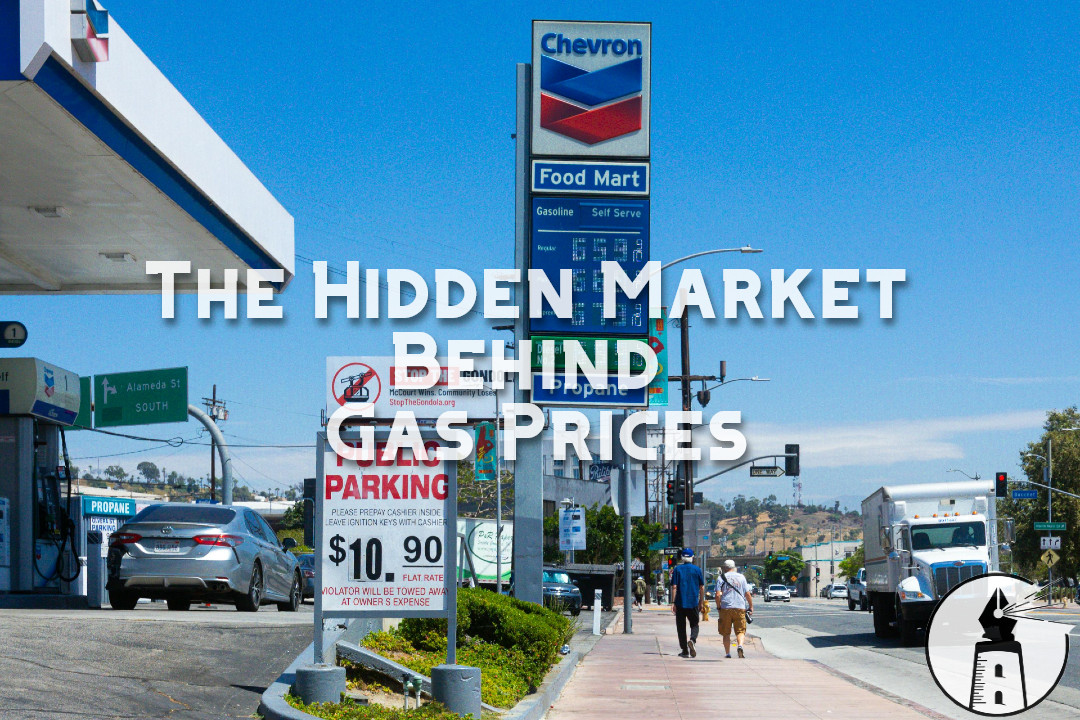
For most Americans, the price of gasoline feels deeply personal. It determines commuting costs, shipping prices, airline tickets, and, indirectly, the cost of groceries and consumer goods. Yet despite how immediate those price increases feel, the forces driving them are often far removed from local gas stations or even domestic oil production. The global oil speculation market, along with geopolitical flashpoints like the Strait of Hormuz, plays a major role in determining what consumers ultimately pay at the pump.
That relationship has become increasingly visible during periods of international tension. Even before a single supply disruption occurs, fears about instability in major oil transit routes can send crude oil futures higher, raising gasoline prices worldwide. Understanding how that process works requires looking beyond local supply and demand and into the structure of the global energy market itself.
Oil Is Priced Globally, Not Locally
Although many consumers think of gasoline prices as tied primarily to domestic production, oil is fundamentally a global commodity. Prices are influenced not just by how much oil a country produces but by expectations about future supply, transportation, refining capacity, and geopolitical risk.
The benchmark prices most commonly referenced are Brent Crude and West Texas Intermediate. These benchmarks are traded on futures exchanges where investors, energy companies, banks, and speculators buy and sell contracts based on what they believe oil will cost in the future.
The U.S. Energy Information Administration explains that gasoline prices are heavily influenced by crude oil costs, which typically account for more than half the retail price of gasoline.
That means even if local supplies remain stable, prices can rise quickly if traders believe future disruptions are likely.
The Role of Speculation
Speculation is often misunderstood. In financial markets, speculators are traders who buy and sell contracts based on expected future price movements rather than direct physical use of the commodity. In oil markets, these participants include hedge funds, institutional investors, banks, and commodity traders.
Critics argue that excessive speculation can inflate prices beyond what supply and demand fundamentals justify. Supporters counter that speculation provides liquidity and helps markets efficiently price risk.
The Commodity Futures Trading Commission oversees futures markets and has repeatedly examined the role speculative trading plays in oil price volatility.
What matters for consumers is that oil markets respond not only to actual shortages but also to perceived threats. If traders believe a future disruption is possible, they may bid prices upward immediately. Those increases ripple through refineries, distributors, and eventually local gas stations.
In practice, this means Americans can experience higher gasoline prices even when there has been no interruption in supply.
Why the Strait of Hormuz Matters
Few locations illustrate this dynamic more clearly than the Strait of Hormuz. Positioned between Iran and Oman, the narrow waterway connects the Persian Gulf to the Gulf of Oman and the Arabian Sea. It is one of the most strategically important shipping routes in the world.
According to the U.S. Energy Information Administration, roughly one-fifth of global petroleum liquid consumption moves through the Strait of Hormuz.
That concentration creates enormous vulnerability. Any threat to shipping in the region can trigger immediate reactions in energy markets because traders understand how difficult it would be to replace that flow quickly.
Over the years, tensions involving Iran, attacks on shipping vessels, drone strikes, and military confrontations have repeatedly pushed oil prices higher. In many cases, prices rose before any long-term supply disruption occurred. The market reaction itself was driven largely by fear and uncertainty.
Perception Often Moves Markets Faster Than Reality
One of the defining features of commodity markets is that perception can move faster than physical supply chains. Oil traders do not wait for tankers to stop moving before reacting. Markets price in expectations almost instantly.
This is why geopolitical headlines can affect gasoline prices within days. A military escalation near the Strait of Hormuz can increase crude futures prices almost immediately because traders anticipate possible shortages or insurance risks for shipping companies.
The International Energy Agency has repeatedly warned that geopolitical instability in key transit routes remains one of the biggest risks to global energy markets.
Insurance costs for oil tankers can also rise sharply during periods of instability, adding another layer of expense that eventually reaches consumers. Even rumors of disruptions can create market volatility because oil pricing depends heavily on confidence and predictability.
How Gas Prices Reach Consumers
By the time oil reaches a local gas station, it has passed through a long chain involving producers, shipping companies, refiners, wholesalers, and retailers. Each stage responds to movements in crude oil prices.
The American Automobile Association regularly tracks national gasoline prices and notes that fluctuations in crude oil futures are among the strongest drivers of retail price changes.
This explains why consumers often notice price spikes quickly but experience slower declines when oil prices fall. Retail pricing tends to react rapidly to expected cost increases while adjusting more gradually downward as inventories purchased at higher prices move through the system.
Regional factors also matter. Refinery outages, seasonal fuel blends, state taxes, and transportation costs can all influence local pricing. However, global crude markets remain the foundation.
Politics and Public Frustration
High gasoline prices frequently become political flashpoints. Presidents often receive blame or credit for prices that are largely shaped by international markets outside direct government control.
That political reality has led administrations from both parties to emphasize domestic oil production, strategic petroleum reserves, and diplomatic engagement with oil-producing nations. Yet even significant increases in domestic production do not fully shield the United States from global pricing pressures.
The interconnected nature of oil markets means that disruptions abroad affect domestic prices regardless of where the oil originates. American producers still sell into a global market where prices are determined internationally.
This can create frustration among consumers who expect local production to translate directly into lower prices. In reality, oil companies respond primarily to global benchmarks and shareholder expectations rather than purely domestic conditions.
Strategic Chokepoints and Economic Vulnerability
The Strait of Hormuz is not the only vulnerable shipping route in the global energy system, but it is among the most important. Analysts often describe it as a “chokepoint” because so much supply moves through a narrow geographic corridor.
The U.S. Energy Information Administration identifies several global chokepoints where disruptions could significantly impact oil markets, including the Suez Canal and the Bab el-Mandeb Strait.
Still, Hormuz remains uniquely sensitive because of the sheer volume of oil involved and the region’s long-standing geopolitical tensions.
As long as global energy systems depend heavily on oil transported through vulnerable routes, markets will remain highly reactive to instability.
Speculation, Fear, and Everyday Costs
The relationship between oil speculation and gasoline prices ultimately comes down to uncertainty. Markets attempt to predict future conditions, and traders price risk into oil contracts long before consumers see the effects directly.
That process can seem abstract, but its consequences are immediate. Higher gasoline prices affect household budgets, freight costs, inflation, and consumer confidence. They also reinforce how interconnected the global economy has become.
A confrontation thousands of miles away in the Strait of Hormuz can influence the cost of commuting to work in the United States within days. That connection exists not because oil physically disappears overnight, but because financial markets respond to perceived risk with extraordinary speed.
Final Thoughts
The oil speculation market occupies a powerful position in the global economy. While physical supply and demand remain central to pricing, expectations, fears, and geopolitical tensions increasingly shape what consumers pay for energy.
The Strait of Hormuz illustrates this reality clearly. Its strategic importance means that instability there reverberates throughout global markets, affecting futures contracts, shipping costs, and ultimately gasoline prices at local pumps.
For consumers, the result is a system where prices are influenced not just by how much oil exists, but by how secure markets believe the future supply will be. In that environment, speculation becomes more than a financial exercise. It becomes one of the forces shaping everyday economic life.
—Greg Collier