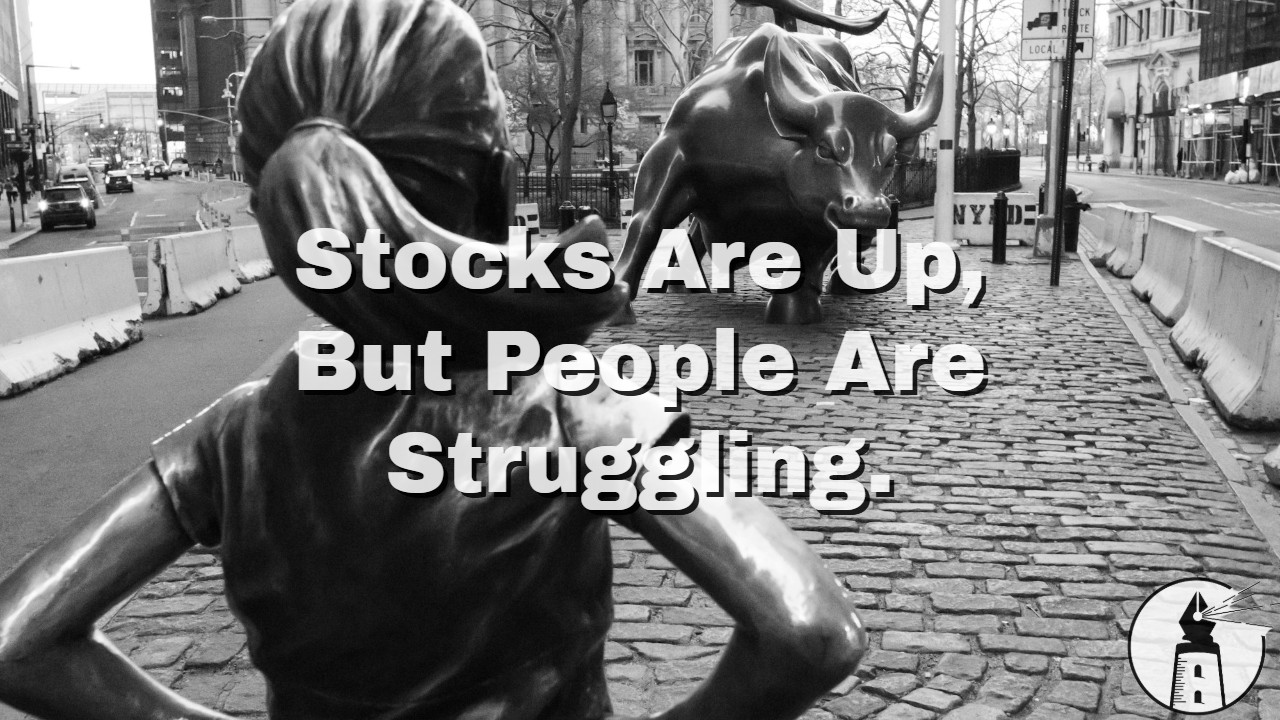
When the stock market rises, headlines often declare that the economy is strong. When it falls, commentators warn of a looming recession. The two are treated as interchangeable signals, as if a rising index automatically means rising prosperity and a falling one means broad decline.
This framing is convenient, but it is misleading.
The stock market reflects the valuation of publicly traded corporations. The economy reflects the lived reality of households, workers, small businesses, and communities. These spheres overlap, but they are not the same. Confusing them obscures inequality, distorts policy debates, and narrows our understanding of what economic health actually means.
What the stock market actually measures
At its core, the stock market measures the price investors are willing to pay for ownership shares in publicly traded companies. These prices are shaped by expectations about future profits, interest rates, global demand, corporate strategy, and investor sentiment.
When the S&P 500 rises, it means investors believe the largest publicly traded firms will generate strong earnings relative to risk. It does not necessarily mean wages are rising, healthcare is affordable, housing is accessible, or families feel financially secure.
Research from the Federal Reserve makes this distinction clear. The Fed’s Distributional Financial Accounts show that stock ownership is highly concentrated among wealthier households. The top 10 percent of households by wealth own the overwhelming majority of corporate equities and mutual fund shares.
This means stock market gains accrue disproportionately to those who already hold significant financial assets. For households without substantial equity exposure, market rallies may have little direct impact on day-to-day economic security.
Wealth concentration shapes who benefits
The idea that a rising stock market lifts all boats assumes broad participation in equity ownership. That assumption does not reflect reality.
According to data from the Federal Reserve’s Survey of Consumer Finances, a substantial portion of U.S. households hold no stock at all, either directly or through retirement accounts. Even among those who do, the dollar value of holdings varies dramatically by income and wealth level.
This concentration matters because stock gains translate into increased wealth primarily for higher-income households. Meanwhile, lower-income households rely more heavily on wages, government benefits, and small business income. These sources may stagnate or decline even as equity markets climb.
This divergence has been visible in recent years. Periods of strong stock performance have coincided with rising housing costs, medical debt burdens, and uneven wage growth. For many families, the daily economy feels constrained even when financial markets are booming.
Corporate profits are not the same as worker prosperity
Stock prices are heavily influenced by corporate profitability. When firms increase margins, reduce costs, or expand market share, investors respond positively.
But profit growth does not automatically translate into wage growth. Research from the Economic Policy Institute shows that since the late 1970s, productivity has grown substantially faster than typical worker compensation.
In other words, companies have become more productive and profitable without proportional gains for many workers. This divergence helps explain why stock indices can reach record highs while real wages for certain segments of the workforce remain flat.
Stock buybacks provide another example. Publicly traded firms often use surplus cash to repurchase shares, which can increase earnings per share and boost stock prices. A study from the Securities and Exchange Commission has examined the growth of buybacks and their impact on markets.
Buybacks can reward shareholders without necessarily expanding hiring or raising wages. The stock market may celebrate these moves even if the broader labor market does not.
Small businesses are largely invisible to markets
The stock market tracks publicly traded companies. The U.S. economy includes millions of small businesses that are not publicly listed.
According to the U.S. Small Business Administration, small businesses account for a significant share of employment and economic activity. Yet their performance is not directly captured by major indices like the S&P 500 or Dow Jones Industrial Average.
A downturn that hits local retailers, independent contractors, or family-owned firms may not register immediately in stock prices, especially if large multinational corporations continue to post strong earnings.
This disconnect became visible during the early stages of the COVID-19 pandemic. Financial markets recovered relatively quickly after initial declines, while many small businesses faced prolonged disruption. The recovery of asset prices did not automatically mean recovery for local economies.
Employment and GDP tell a different story
Economists rely on a range of indicators to assess economic health, including gross domestic product, unemployment rates, labor force participation, and wage growth.
The Bureau of Labor Statistics tracks employment conditions, revealing fluctuations that may not align with stock performance.
The Bureau of Economic Analysis reports GDP data that capture overall output but still do not reflect distribution.
There have been periods when unemployment fell and wages rose while markets experienced volatility. There have also been times when markets surged despite stagnant labor force participation.
These differences highlight a fundamental point. The stock market reflects investor expectations about corporate earnings. The economy reflects production, employment, and income distribution. The two can move together, but they can also diverge significantly.
Financial markets respond to policy differently than households
Monetary policy illustrates another divide.
When the Federal Reserve lowers interest rates, equity markets often react positively because lower rates can increase corporate borrowing, support asset valuations, and make bonds less attractive relative to stocks.
For households, the impact may be mixed. Lower rates can reduce mortgage costs but may also signal economic weakness. Conversely, higher rates can cool stock prices while increasing borrowing costs for families seeking home loans or car financing.
The Federal Reserve’s own communications emphasize that its dual mandate focuses on maximum employment and stable prices, not stock performance.
Yet media coverage frequently treats market reactions as shorthand for economic success or failure. This framing centers investor experience rather than household experience.
Sentiment and speculation amplify the gap
Stock prices incorporate expectations about the future, not just present conditions. Investor optimism about emerging technologies, geopolitical shifts, or anticipated policy changes can drive valuations independent of current economic realities.
Academic research on asset pricing indicates that markets are influenced by sentiment, momentum, and behavioral biases.
This means markets can overreact to news or price in scenarios that never materialize. The broader economy, anchored in real production and labor, moves more slowly.
Speculative enthusiasm can lift markets even when many households are struggling with inflation, healthcare costs, or housing affordability. The emotional tone of financial news may not match lived experience.
Why the distinction matters
Conflating the stock market with the economy has policy consequences.
When rising indices are treated as proof of prosperity, structural issues such as wage stagnation, housing shortages, medical debt, or regional decline may receive less attention. Policymakers may prioritize investor confidence over household stability.
Public perception also shifts. If people are told the economy is strong because markets are up, yet their personal finances feel strained, trust in institutions can erode. The gap between macro signals and daily reality fuels skepticism.
Understanding that the stock market is not the economy allows for a more honest conversation about distribution, opportunity, and resilience.
The bottom line
The stock market measures the valuation of publicly traded corporations. The economy encompasses the full range of production, labor, consumption, and lived financial experience.
Because stock ownership is concentrated, gains flow disproportionately to wealthier households. Because corporate profits do not automatically translate into wage growth, market rallies can coexist with stagnant pay. Because small businesses and local conditions are not fully captured by major indices, community-level hardship can remain invisible to investors.
Financial markets matter. They influence retirement savings, corporate investment, and global capital flows. But they are only one piece of a much larger system.
Treating the stock market as a proxy for economic health narrows our vision. A truly healthy economy cannot be measured solely by the performance of its largest firms. It must be evaluated by how broadly opportunity, stability, and prosperity are shared.
The numbers on a ticker are not the same as the lives behind them.
—Greg Collier