“The science is settled” is one of the most common phrases in modern public debate and one of the most misunderstood. People use it to signal confidence, to end arguments, and to draw a bright line between informed policy and denialism. Sometimes it is deployed in good faith. Often it is used as a rhetorical shortcut. Either way, it tends to distort what science actually is.
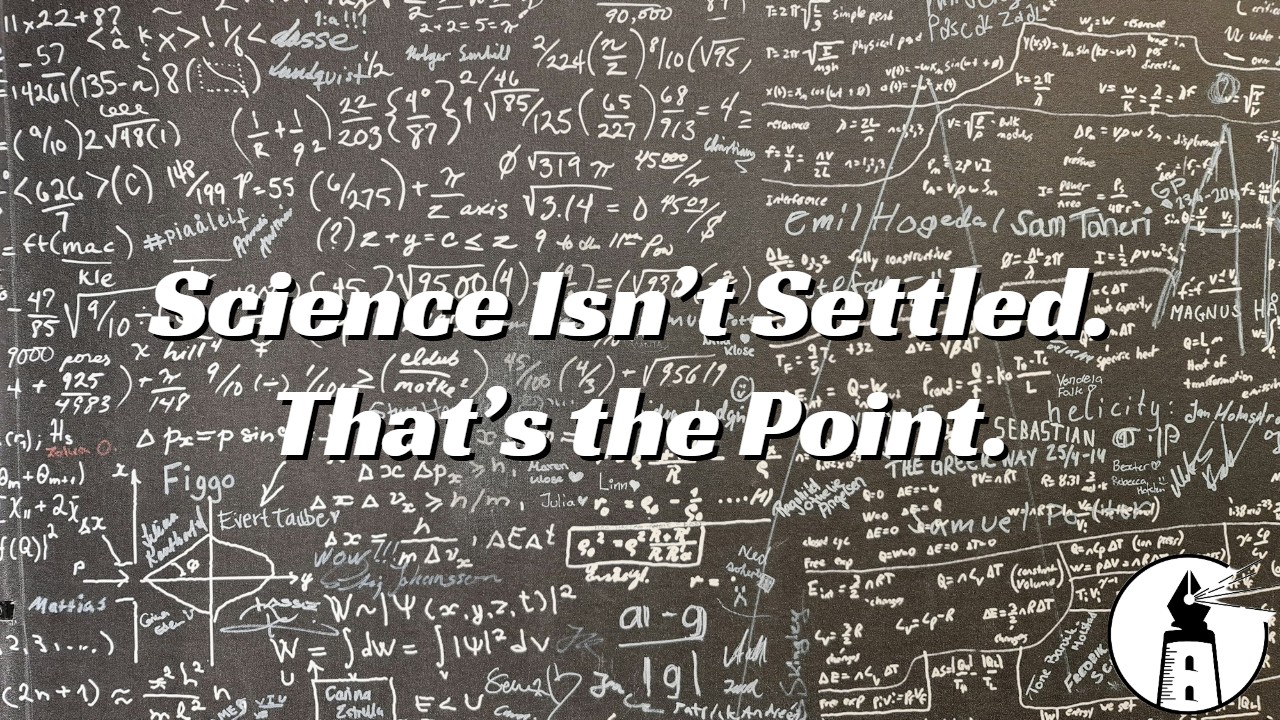
Science is not a fixed set of answers. It is a disciplined method for reducing uncertainty. It produces knowledge that can be extraordinarily reliable, but that reliability comes from a process that is iterative, self-correcting, and always conditional on new evidence. That is why “settled” is usually the wrong frame. It encourages people to treat science like scripture rather than a tool for understanding a complicated world.
The better question is not whether science is “settled.” The better questions are how strong the evidence is, how much uncertainty remains, what would change our minds, and what decisions make sense under that uncertainty?
Science is a process, not a verdict
One reason the phrase misleads is that it treats science as a final ruling that arrives, shuts the door, and ends debate. But major scientific institutions describe science differently.
The National Academies emphasizes that science is complex and that it is simultaneously a process, a product, and an institution. Science literacy is not just memorizing facts. It includes understanding how knowledge is produced and revised.
The National Academies also states the point more plainly in work on scientific integrity and data: scientific claims are subject to questioning, challenge, and refinement as new questions are asked and new data are generated. That uncertainty is not a flaw. It is part of what makes science reliable over time.
When people hear “settled,” they often interpret it as “finished.” Science rarely works that way. Even strong conclusions remain open to refinement because the world keeps producing new data, better methods, and more precise measurements.
Uncertainty is not ignorance
Another reason “settled” is misleading is that it collapses a crucial distinction: uncertainty is not the same thing as not knowing anything.
In many fields, scientists can be confident about the direction of an effect while still uncertain about the exact magnitude, timing, or mechanisms. Climate science is a clear example, not because it is uniquely uncertain, but because it has developed some of the most rigorous public-facing methods for communicating uncertainty.
The Intergovernmental Panel on Climate Change uses calibrated language to describe both confidence and likelihood, with explicit guidance on how authors should express uncertainty in assessment findings. The point of that framework is not to weaken conclusions. It is to prevent overstatement and help decision-makers understand what is known, what is likely, and what remains less certain.
This is how mature science behaves. It does not demand that uncertainty vanish before action is justified. It tries to quantify uncertainty so decisions can be made intelligently under imperfect information.
“Settled” often confuses consensus with certainty
Sometimes “settled” is meant to say, “There is a strong scientific consensus.” That can be a meaningful claim. But consensus and certainty are not identical.
Consensus is a social and institutional outcome. It reflects the collective judgment of experts after evidence has been tested, debated, replicated, and synthesized. Certainty is a philosophical and statistical concept. It concerns how confident we should be that a claim is true, given the data and assumptions.
Consensus can be strong and still evolve. It can also be strong in one aspect of a question and weaker in another. When people say “settled,” they often imply a single monolithic conclusion, when the reality is usually a cluster of conclusions with varying degrees of confidence.
This is important for public trust. When new evidence refines a prior view, audiences that were promised “settled” science may interpret refinement as failure or dishonesty. In reality, refinement is how science earns trust over time.
Falsifiability and the point of testing
Science advances by putting claims at risk. That is why philosophers of science have emphasized testability and the possibility of refutation. Karl Popper famously argued that scientific theories should be framed in ways that expose them to being proven wrong by evidence.
You do not have to adopt Popper as a religion to appreciate the practical lesson. Good science is not a set of statements that can never be challenged. It is a set of statements that have survived serious attempts to challenge them.
If a claim is truly immune to revision, then it is not behaving like a scientific claim. It is behaving like a slogan.
The public hears certainty because communicators fear doubt
A major driver of “the science is settled” is not scientists, but the ecosystem around science. Public officials want clear guidance. Journalists want clean narratives. Advocates want decisive language. Everyone worries that acknowledging uncertainty will be exploited.
There is truth in that worry. Bad faith actors often weaponize uncertainty to claim nothing can be known and therefore nothing should be done. But the solution to that problem is not to pretend uncertainty does not exist. The solution is to communicate uncertainty responsibly.
A frequently cited paper in the Proceedings of the National Academy of Sciences makes the core point: all science has uncertainty, and if uncertainty is not communicated effectively, decision-makers may put too much or too little faith in the evidence.
In other words, uncertainty is not the enemy of decision-making. Misunderstood uncertainty is.
“Settled” is sometimes a political move, not a scientific one
The phrase also becomes misleading because it is often used to shut down disagreement that is not actually anti-science.
There is a difference between rejecting evidence and debating values. Science can inform policy, but it cannot decide what society ought to prioritize. It can estimate risks, costs, and likely outcomes, but it cannot declare which tradeoffs are morally acceptable.
When someone says “the science is settled,” they may be trying to end a debate that is partly about values, economics, and governance. That is tempting because it turns a messy political argument into an allegedly technical one.
But it is risky. When science is used as a substitute for democratic argument, people begin to distrust science as a political weapon rather than a method for understanding reality.
Why “settled” backfires when evidence evolves
Even when people mean well, “settled” can boomerang. Public trust breaks not because science changes, but because audiences were told it would not.
During fast-moving crises, that dynamic becomes more visible. Guidance changes as evidence improves, as contexts shift, and as tradeoffs become clearer. People who expect static answers experience normal scientific revision as betrayal.
Research on science communication has noted that uncertainty is ubiquitous, but scientific knowledge is often represented publicly as certain and immutable, and that contrast can foster distrust when people perceive guidance as “reversals.”
The mistake is not that guidance changes. The mistake is selling the public a fantasy in which knowledge never updates.
A better way to talk about strong science
None of this means that everything is always uncertain or that strong scientific conclusions are fragile. Some conclusions are extraordinarily robust. The reality of gravity, the germ theory of disease, and the link between smoking and lung cancer are not hanging by a thread.
The problem is the framing. Strong science is not “settled” in the sense of being beyond revision. It is “settled” in the practical sense that the evidence is so overwhelming and the explanatory framework so successful that it would take extraordinary new findings to overturn it. Even then, what usually happens is refinement, not reversal.
Scientific institutions also recognize that public trust depends on transparency about how knowledge is produced and revised. The Royal Society has argued that trust often depends less on personal familiarity with evidence and more on confidence in scientific practice and standards, which in turn depends on openness and effective communication within expert communities.
That is a more honest model. Trust science because it shows its work, because it invites criticism, because it corrects itself, and because it can explain why a claim is credible.
What we should say instead
If “the science is settled” is misleading, what should replace it?
We should say what we actually mean. We should describe confidence, uncertainty, and the decision context. We should distinguish between debates about facts and debates about values. We should acknowledge what is unknown without implying that nothing is knowable.
Science does not need to be framed as infallible to be authoritative. In fact, treating science as infallible makes it more vulnerable, because every revision looks like a crack in the foundation.
The stronger message is simpler and more durable: science is our best tool for learning what is true, and it stays trustworthy precisely because it is willing to change when reality demands it.
—Greg Collier