American constitutional design rests on a theory of balance. Congress writes the laws. The president executes them. The courts interpret them. Each branch checks the others. Power is divided to prevent accumulation.
In practice, power tends to flow in one direction.
Over the course of American history, executive authority has expanded during moments of crisis and rarely returned to its prior boundaries. Wars, economic collapses, terrorist attacks, pandemics, and immigration surges have all served as catalysts. Presidents assert emergency authority. Congress delegates broad discretion. Courts defer in the name of national security or administrative expertise. When the immediate crisis fades, the underlying authorities often remain.
This pattern is not partisan. It is structural.
The constitutional baseline and its evolution
Article II of the Constitution vests “the executive Power” in the president. Compared to Article I, which carefully enumerates congressional powers, Article II is sparse. That brevity has allowed successive administrations to interpret executive authority broadly.
Early in the republic, presidential power was relatively limited in practice. Congress dominated domestic policy. Over time, however, the demands of a growing nation and global engagement expanded the executive’s role.
The Supreme Court acknowledged this trajectory in Youngstown Sheet & Tube Co. v. Sawyer, a case arising from President Harry Truman’s attempt to seize steel mills during the Korean War. The Court rejected the seizure, but Justice Robert Jackson’s concurring opinion laid out a framework recognizing that presidential power is at its maximum when acting with congressional authorization and at its lowest when acting against Congress.
Jackson’s opinion remains foundational because it implicitly recognized how often Congress authorizes or tolerates expansive executive action.
War and national security as engines of expansion
Major expansions of executive power have frequently occurred during wartime.
President Abraham Lincoln suspended habeas corpus during the Civil War. President Franklin Roosevelt issued Executive Order 9066, authorizing the internment of Japanese Americans during World War II, a policy upheld at the time in Korematsu v. United States.
Although Korematsu was formally repudiated decades later, the case illustrates how courts often defer to executive claims of emergency.
The post-9/11 era marked another significant expansion. Congress passed the Authorization for Use of Military Force in 2001, granting the president broad authority to pursue those responsible for the attacks. That authorization has been cited by multiple administrations to justify military actions far beyond the original battlefield.
The Supreme Court in Hamdi v. Rumsfeld acknowledged limits but still recognized the executive’s authority to detain enemy combatants under the AUMF.
Emergency authority invoked during war has a tendency to become normalized.
The growth of the administrative state
Executive power has also expanded through the rise of administrative agencies.
Congress often enacts broadly worded statutes and delegates rulemaking authority to agencies. Those agencies, which are part of the executive branch, then craft detailed regulations that shape entire sectors of the economy.
The Administrative Procedure Act governs this process, but the discretion granted to agencies can be substantial.
Over time, presidents have used executive orders and agency directives to steer policy in areas ranging from environmental regulation to immigration enforcement.
Courts historically deferred to agency interpretations under doctrines such as Chevron deference, established in Chevron U.S.A., Inc. v. Natural Resources Defense Council, Inc.
Although the Supreme Court recently limited Chevron’s reach, decades of deference allowed executive agencies to wield significant policymaking influence.
This delegation dynamic reflects congressional incentives. Legislators avoid taking politically difficult votes by granting agencies broad authority. The executive branch then fills in the details. Once authority is transferred, it is rarely fully reclaimed.
Emergency declarations and enduring authority
Modern presidents have access to a wide array of statutory emergency powers.
The Brennan Center for Justice has cataloged more than one hundred provisions of federal law that can be activated during a declared national emergency.
These include powers related to military construction, sanctions, communications control, and domestic deployment.
National emergencies, once declared, can persist for years. According to the Congressional Research Service, dozens of declared national emergencies remain in effect simultaneously, some dating back decades.
While emergencies are intended to address immediate threats, their continuation often reflects inertia rather than active review.
Congress technically retains the authority to terminate emergencies, but doing so requires political consensus that is often difficult to achieve.
Judicial deference and institutional incentives
Courts play a crucial role in defining the limits of executive authority. Yet the judiciary frequently defers to the executive branch in matters framed as national security, foreign affairs, or administrative expertise.
In Trump v. Hawaii, the Supreme Court upheld the president’s authority to restrict entry from certain countries, citing statutory authorization and executive discretion in immigration matters.
The decision underscored how broad statutory language can enable sweeping executive action, especially when courts are reluctant to second-guess executive judgments.
This deference is not inherently improper. Courts recognize institutional limits in evaluating classified intelligence or military strategy. However, deference accumulates over time, reinforcing executive discretion.
Congressional abdication and political reality
Executive power expands not only because presidents assert it, but because Congress often tolerates it.
Legislators may prefer to criticize executive action rather than constrain it through legislation. Political polarization further complicates oversight. When the president and congressional majorities share party affiliation, institutional rivalry can soften. When they differ, gridlock can prevent effective recalibration of authority.
The Congressional Research Service has repeatedly noted that Congress possesses tools to oversee and limit executive action, including appropriations power and statutory revision.
Yet exercising those tools requires sustained political will.
Delegation is easier than reclamation.
Why contraction is rare
Once executive authority expands, several forces make contraction unlikely.
First, presidents are disinclined to surrender tools that enhance flexibility. Even administrations that criticize executive overreach often retain inherited powers once in office.
Second, Congress benefits from shifting responsibility. Broad delegation allows members to avoid direct accountability for controversial decisions.
Third, courts hesitate to dismantle longstanding frameworks absent clear constitutional violation.
Finally, crises recur. Each new emergency justifies fresh assertions of authority layered atop existing ones.
Over time, the ratchet effect becomes evident. Powers accumulate faster than they are withdrawn.
The democratic tension
The expansion of executive authority is not inherently illegitimate. Modern governance requires speed and coordination. Foreign policy and national defense often demand unified command. Regulatory complexity requires specialized agencies.
The tension arises when temporary measures become permanent features, and when oversight mechanisms weaken relative to the scale of authority exercised.
The Constitution envisions a system in which ambition counteracts ambition. If institutional incentives shift toward cooperation or passivity, that balance can erode without dramatic confrontation.
The bottom line
Executive power in the United States has grown steadily across administrations of both parties. War, economic crises, terrorism, and public health emergencies have all provided rationales. Congress has delegated broadly. Courts have often deferred. Presidents have accepted and extended inherited authorities.
The pattern is not the product of a single leader. It reflects structural incentives embedded in modern governance.
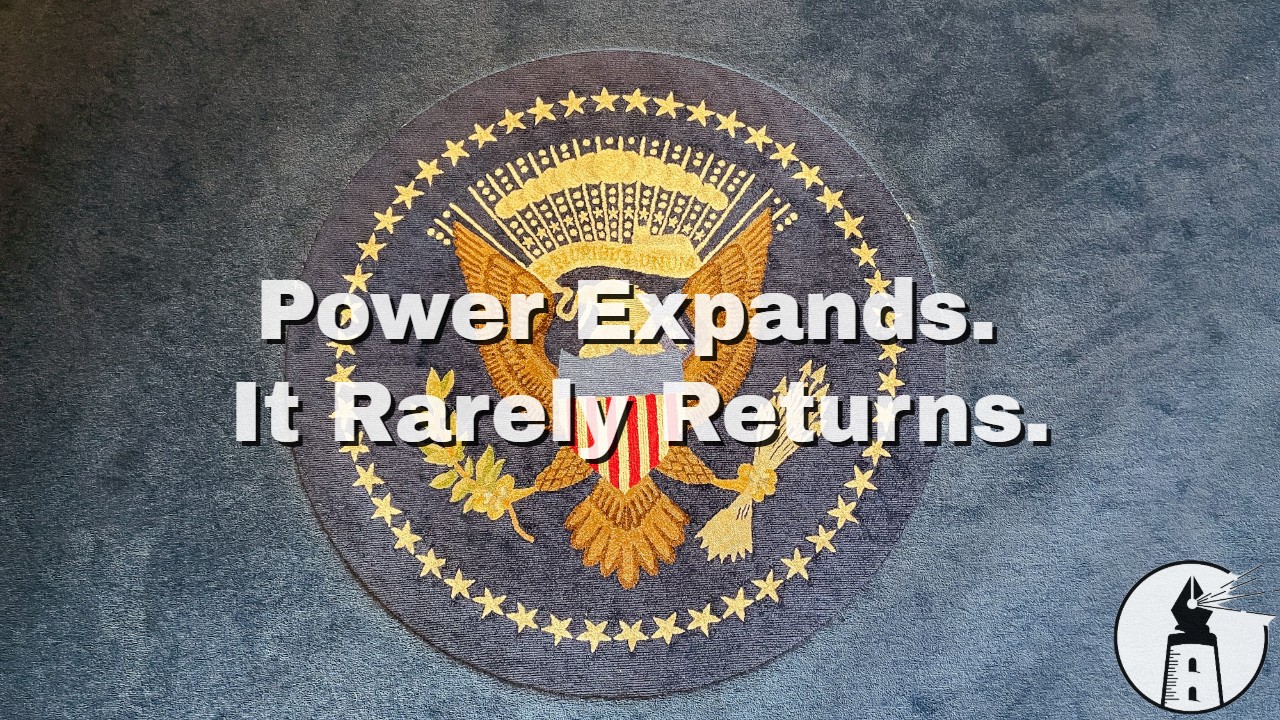
History suggests that once authority is centralized in the executive branch, it is rarely fully returned. The question is not whether executive power will expand during crises. It almost certainly will. The more difficult question is whether institutions will meaningfully recalibrate once the crisis passes.
The health of a constitutional system depends not only on its capacity to act decisively but also on its willingness to restore equilibrium. Experience shows that expansion is easy. Contraction is rare.
—Greg Collier