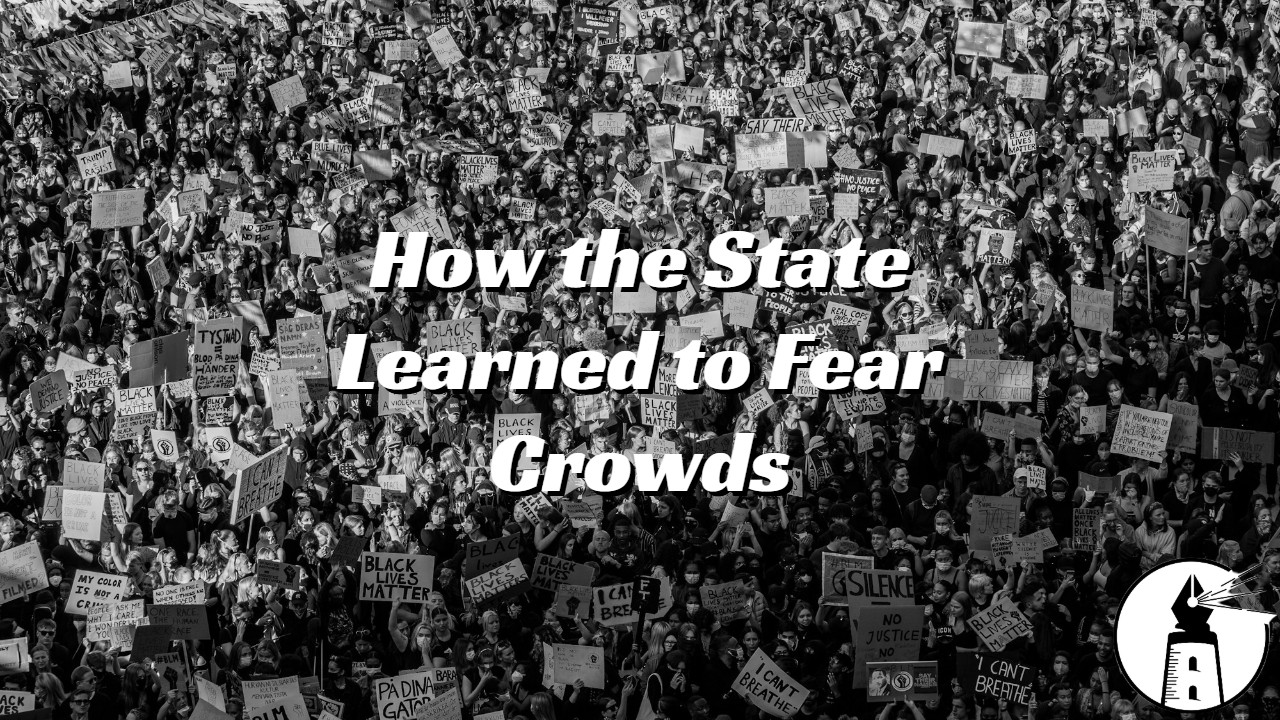
For most of American history, public protest has been treated, at least in principle, as a civic pressure valve. Loud, inconvenient, sometimes disorderly, but fundamentally part of democratic life. The First Amendment doesn’t exist to protect polite agreement. It exists to protect dissent.
And yet, in the last couple of decades, something has shifted. Protest is increasingly described not as a political act but as a security problem. An operational challenge to be managed, dispersed, or contained. The change isn’t just rhetorical. It shows up in tactics (chemical agents, kinetic impact munitions, aggressive crowd-control formations), in personnel (federal agents deployed into protest environments), and in the legal posture that often follows (broad deference to “officer safety,” narrow tolerance for disruption, and remedies delayed by procedure).
So when did protest become a “security threat”? Not on a single date. It happened gradually, through a chain of incentives and institutional habits that normalize force and reframe constitutional activity as risk.
The oldest pattern: discretion disguised as “order”
The tension between protest and authority is not new. What is new is how routinely the “order” frame wins by default.
In Cox v. Louisiana (1965), the Supreme Court confronted a familiar problem. Local officials were using vague “public order” rationales to restrict demonstrations. The Court warned against “unfettered discretion” in regulating peaceful assemblies because discretion is where viewpoint discrimination hides.
That case belongs to the civil rights era, but the principle is evergreen. If the government can treat protest as a movable threat to “public order,” then speech rights become contingent, protected only when officials feel comfortable.
Today’s security framing is that same impulse, scaled up, professionalized, and backed by tactical doctrine.
Post-9/11 mission creep: the rise of security logic everywhere
A major accelerant is the post-9/11 expansion of the security state, with new funding streams, new interagency coordination, and a cultural shift inside law enforcement toward “threat” paradigms. Once the dominant institutional question becomes, “What could go wrong?” the operational bias is toward control.
That bias does not automatically produce abuse. But it does produce a predictable logic:
- Crowds are treated as inherently unstable
- Disorder is treated as escalation
- Visibility is treated as vulnerability
- Force is treated as prevention
In that mindset, protest is not a political act to be accommodated; it’s an environment to be dominated.
The federal turn: when “property protection” becomes protest policing
One of the clearest signals that protest has been reclassified as security work is the expanding federal presence in protest contexts.
After the 2020 Portland protests, the Department of Homeland Security Inspector General issued findings about DHS’s deployment and preparations for protecting federal property—precisely the sort of “narrow mission” that can slide into broader crowd-control activity when conditions allow.
At the same time, the Department of Justice Office of the Inspector General reviewed DOJ’s response during protest activity and civil unrest in Washington, D.C., in late May and early June 2020, examining roles and responsibilities across DOJ components. That report matters because it documents how quickly protest environments become treated as a multi-agency security operation rather than a First Amendment context demanding restraint.
You don’t need to agree with every protest slogan to recognize the structural issue. As federal involvement grows, so does distance from local oversight and local political accountability. Federal agencies are not municipally governed. Their internal review processes are less visible to the public. Their incentives are different. And once federal tactics become normal in protest settings, the boundary between “narrow mission” and general-purpose street enforcement gets harder to see.
The gear and the optics: why “militarized” isn’t just aesthetics
A recurring feature of protest policing is tactical appearance. Face coverings, military-style equipment, long guns, ballistic protection, and aggressive formations. Supporters argue that gear reduces officer injuries. Critics argue that the gear escalates crowds by making the state look like an occupying force. Both can be true.
What matters is that this gear communicates a premise: the public is potentially hostile. Once that premise is accepted, protest is no longer a democratic practice; it is a security scenario.
And security scenarios have playbooks. Those playbooks often prioritize speed, control, and compliance over constitutional patience.
The chemical-agent era: when “less-lethal” becomes routine
Nothing captures the reclassification of protest better than the normalization of chemical irritants and other “less-lethal” weapons in crowd settings.
International human rights guidance emphasizes that “less-lethal” does not mean harmless—and that indiscriminate effects in assemblies raise serious proportionality concerns. The UN Office of the High Commissioner for Human Rights’ guidance on less-lethal weapons provides detailed standards aimed at limiting harms, particularly when dispersing assemblies.
Similarly, the OSCE’s Human Rights Handbook on Policing Assemblies stresses necessity, proportionality, and warnings because the harm from force used against crowds is not neatly targeted and not easily undone.
These documents aren’t U.S. law, but they’re useful because they articulate what democratic policing is supposed to be optimizing for: rights protection first, not operational convenience.
The security mindset flips that order. It treats chemical agents as management tools and justifies their use with broad claims about control and safety, claims that often collapse important distinctions between violent actors, peaceful demonstrators, and bystanders.
The narrative weapon: “Myth vs. Fact” and the securitization of dissent
Another marker of the shift is rhetorical. Institutions increasingly frame protest in national-security language: “anarchists,” “violent extremists,” and “threats,” even when the reality is mixed and often includes large numbers of peaceful participants.
During the Portland protests, DHS published messaging that explicitly pushed a security narrative, casting events as sustained “violence” and “chaos” and arguing for federal posture accordingly.
Even if some nights did involve criminal acts, the larger point is how often agencies present protest as a binary: either it is “peaceful” and therefore legitimate, or it is “violent” and therefore everything becomes permissible. That framing is convenient because it allows broad tactics to be defended without doing the hard constitutional work of separating culpable conduct from protected activity.
Once that framing takes hold, protest becomes a threat category, not a protected right.
The accountability gap: security logic thrives where oversight is thin
A security posture tends to expand fastest where oversight is weakest.
Local police departments, imperfectly, operate under municipal politics, state law constraints, open records rules, civilian review structures, and local media ecosystems. Federal agencies typically operate under a more opaque accountability model. Internal review, limited public visibility, and legal doctrines that can make lawsuits difficult.
That’s one reason watchdog and inspector-general reports matter. They are among the few public-facing mechanisms capable of documenting what happened and how decisions were justified.
But the deeper point is structural. When protest is treated as “security,” the public is asked to defer, to accept that the state’s operational instincts are self-justifying. Over time, deference becomes the default posture, and constitutional inquiry becomes an afterthought.
The procedural problem: delayed rights often become denied rights
Even when courts recognize constitutional harm, the remedy can be slow; injunctions are stayed, cases are prolonged, and disputes are treated as technical.
That legal reality is not new. But it becomes far more dangerous when combined with modern protest policing tactics. Suppressed speech cannot be retroactively restored. A protest chilled by force cannot be reassembled later in the same moment of political urgency. That’s why preliminary protections exist in the first place, to prevent ongoing injury while the system deliberates.
Security logic is patient. Democratic protest is not.
So when did it happen?
Protest became a “security threat” when institutions stopped seeing dissent as a civic constant and started seeing it as a risk to be neutralized. The timeline is messy, but the ingredients are clear.
- Post-9/11 threat paradigms expanding beyond terrorism
- Mission creep and federal involvement in protest environments
- Tactical doctrine that prizes control and compliance
- Normalized use of chemical agents and impact munitions
- Messaging that collapses peaceful protest into “disorder”
- Accountability systems that ask the public to trust what it cannot see
None of this requires a conspiracy. It requires only habit, habits reinforced by politics, fear, and bureaucratic incentives.
The democratic test
The test of a free society is not whether it tolerates speech that comforts power. The test is whether it restrains power when speech challenges it.
When protest becomes a “security threat,” constitutional rights don’t disappear in one dramatic moment. They erode through routine decisions: what gear to wear, what tactics to authorize, what stories to tell the public, what remedies to pause, and what accountability to withhold.
And once that erosion is normalized, the question is no longer whether the public has a right to protest. The question becomes whether the state still remembers that protest is not an operational obstacle; it is the sound of democracy doing its job.
—Greg Collier