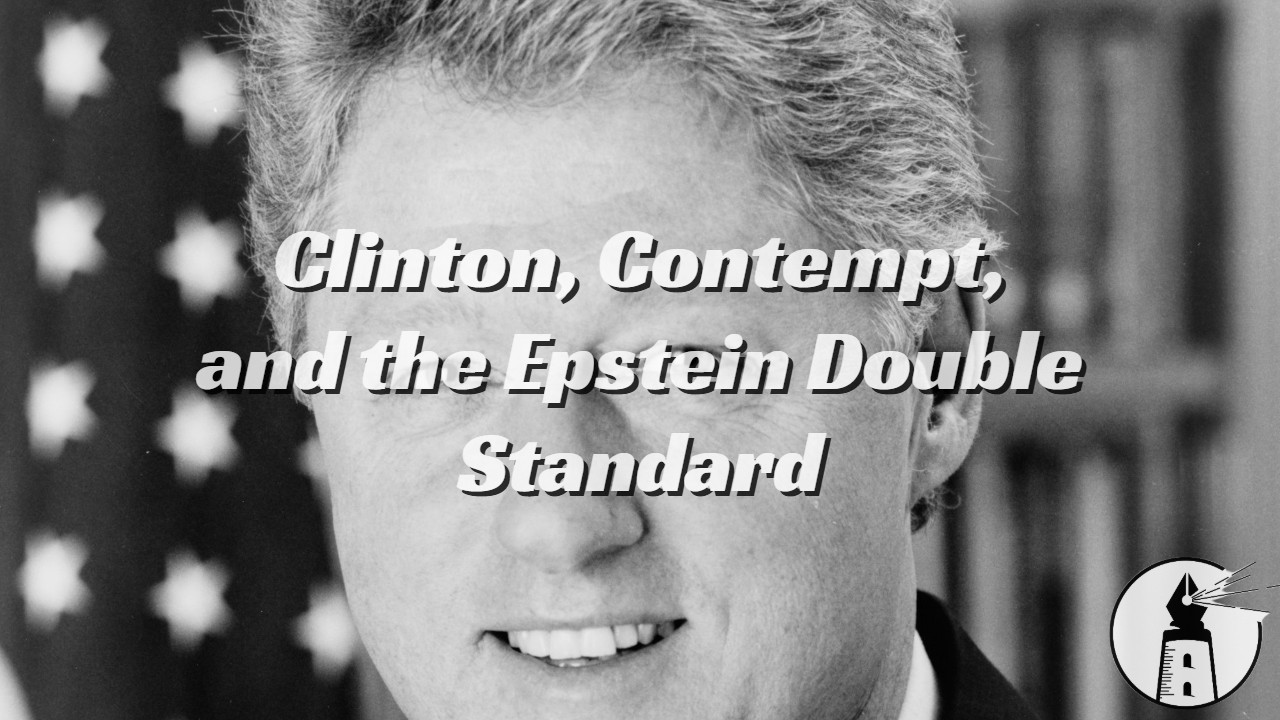
House Republicans are moving to hold Bill Clinton and Hillary Clinton in contempt of Congress for refusing to appear in person before a House panel investigating the late convicted sex offender Jeffrey Epstein.
On its face, that might sound reasonable. Congress has the power to investigate. Witnesses can be subpoenaed. And when people refuse to cooperate, contempt is a tool lawmakers can use.
But once you look more closely at how this investigation is being handled, the situation becomes far more questionable. The issue isn’t whether powerful people should be scrutinized. It’s whether Congress is applying the same rules to everyone and whether this push is actually about uncovering the truth or about steering the story in a politically useful direction.
Written Statements for Some, Contempt for Others
One of the biggest problems with the contempt threat is that the House has not applied a consistent standard to witnesses.
In this same investigation, lawmakers have accepted written statements from other former government officials, including former U.S. attorneys general. Those witnesses were not required to sit for in-person depositions. Written responses were deemed sufficient.
The Clintons, meanwhile, offered written cooperation but declined live testimony. Instead of accepting that option, House Republicans escalated straight to threats of contempt.
That raises a basic question: why is written testimony acceptable for some people but not for others?
Contempt of Congress is supposed to be reserved for people who flat-out refuse to cooperate. It is not usually used as a punishment for disagreeing over the format of testimony, especially when the same format has already been allowed for other witnesses. When rules change depending on who is being targeted, it weakens the legitimacy of the investigation itself.
The Bigger Problem: The Epstein Files Still Aren’t Public
There is another, even larger issue hanging over this entire dispute: the Epstein files themselves.
Despite years of public pressure, court rulings, and congressional interest, the federal government still has not released the full set of Epstein-related records. Large portions remain sealed or withheld by the Department of Justice.
That matters because these files are the most direct source of information about who Epstein associated with, how prosecutors handled his case, and how he was able to avoid accountability for so long. Without full disclosure, any congressional investigation is operating with one hand tied behind its back.
Instead of forcing the release of all records, Congress has allowed partial disclosures, documents released in bits and pieces, often highlighting specific names. When only fragments are released, the public gets a distorted picture. The story becomes about whoever appears in the documents that happen to be made public, not about the full scope of Epstein’s network or the system that protected him.
Transparency doesn’t work if it’s selective.
Why the Focus Keeps Returning to Clinton
This is where politics enters the picture.
Focusing on Bill Clinton has the effect, intentional or not, of pulling attention away from Donald Trump, who appears far more frequently in Epstein-related reporting and allegations. Trump’s past association with Epstein has been documented in court filings, sworn testimony, and investigative journalism.
This does not mean Clinton is blameless. Poor judgment, associations, and proximity to Epstein are all fair subjects of scrutiny. But when one figure becomes the centerpiece of congressional outrage while another with more documented connections receives comparatively little attention, the imbalance is hard to ignore.
The result is a reshaped narrative. Instead of asking how Epstein operated for decades with institutional protection, the public conversation becomes a familiar political fight centered on one name.
What Clinton Has Actually Said About the Files
Bill Clinton has publicly stated that all Epstein-related files should be released, regardless of whose names appear in them. That position aligns with what many people across the political spectrum have been asking for: full transparency, no matter who it implicates.
That stance doesn’t prove innocence, and it doesn’t settle questions about responsibility. But it does undermine the idea that Clinton is trying to block information from coming out. Supporting full disclosure is the opposite of obstruction.
Meanwhile, the continued refusal by the Department of Justice to release all records remains the biggest obstacle to public understanding, yet that issue gets far less attention than a high-profile contempt fight.
Oversight or Political Theater?
Congressional investigations are supposed to answer hard questions, not just generate headlines.
In the Epstein case, those questions include:
- Why was Epstein allowed to receive a sweetheart plea deal?
- Who approved it, and why?
- How did he continue abusing people for years afterward?
- What safeguards failed, and who was responsible for enforcing them?
Threatening contempt over a deposition format dispute does little to answer those questions. It does, however, create a spectacle, one that keeps attention focused on partisan conflict rather than institutional failure.
When Congress uses its investigative powers unevenly, it feeds public cynicism. People begin to see these inquiries not as fact-finding missions, but as political tools used to elevate some stories and bury others.
What Real Accountability Would Look Like
If lawmakers are serious about getting answers in the Epstein case, the solution isn’t complicated.
First, apply the same rules to every witness. If written testimony is acceptable for some, it should be acceptable for all.
Second, release the full Epstein files, with only the narrowest legally required redactions. Let the public see the complete record instead of curated excerpts.
Third, focus less on individual political figures and more on how the justice system failed so badly and repeatedly.
Without those steps, contempt threats ring hollow. They look less like a push for accountability and more like an attempt to control the narrative.
Final Thoughts
The Epstein scandal is one of the most disturbing failures of the American legal system in recent memory. It deserves serious, fair, and comprehensive scrutiny.
Selective enforcement, partial disclosure, and headline-driven investigations do not bring the country closer to the truth. They simply shift attention and protect the very systems that allowed Epstein to operate for so long.
If Congress wants credibility, it should stop fighting over who gets dragged into the spotlight and start releasing the information the public has been asking for all along.
—Greg Collier
Further Reading
- House GOP seeks to hold Bill Clinton in contempt for skipping Epstein deposition – NBC News
- House Republicans say they will hold Hillary Clinton in contempt of Congress in Epstein inquiry – ABC News
- Bill and Hillary Clinton refuse to testify in House Epstein probe, could be held in contempt – Reuters
- ‘We Will Forcefully Defend Ourselves’: Clintons Refuse Subpoena in Epstein Inquiry as Republicans Threaten Contempt Proceedings – TIME